








Reliable Manpower Supply in Qatar is essential for businesses that need the right workforce without relying entirely on permanent recruitment. Construction projects, industrial facilities, infrastructure works, hospitality operations, facility management contracts and other businesses often face changing workforce requirements based on project schedules, workload, site conditions and operational demand.
A company may need additional workers for several months, a larger team during a project peak, specific trades for a defined scope of work or general manpower to support ongoing operations. In these situations, a structured manpower supply arrangement can provide greater flexibility than recruiting every worker directly.
The key is not simply finding more workers. Businesses need the correct number of people, with the appropriate skill level, available for the required duration and prepared for the work environment in which they will be deployed.
BTMAQ Trading & Services WLL provides skilled, semi-skilled and unskilled manpower solutions for businesses and projects across Qatar. Its published service coverage includes construction, oil and gas, industrial, infrastructure, logistics, hospitality, cleaning and facility management requirements.
This guide explains how manpower supply works, the main workforce categories and contract models available, how businesses should calculate their requirements, the deployment process, labour-compliance considerations, cost factors and the practical information needed before requesting manpower.
Table of Contents
- What Is Manpower Supply in Qatar?
- Why Businesses Use Manpower Supply Services
- Types of Manpower Available in Qatar
- Flexible Manpower Supply Models
- Labour Hire and Workforce Solutions
- Industries That Depend on Manpower Supply
- How the Manpower Supply Process Works
- Fast Workforce Deployment
- Documentation and Labour Compliance
- How to Calculate Manpower Requirements
- Manpower Supply Cost Factors
- Manpower Supply vs Direct Recruitment
- How to Request Manpower
- Why Choose BTMAQ
- Frequently Asked Questions
What Is Manpower Supply in Qatar?
Manpower supply is a workforce arrangement in which businesses obtain workers according to an agreed operational or project requirement.
Instead of recruiting every employee specifically for a permanent internal position, a business can define the number of workers required, their job categories, skill level, duration, location and working schedule.
The manpower requirement may be connected to:
- A construction project
- An industrial contract
- Facility operations
- Infrastructure development
- Maintenance activity
- Hospitality operations
- Cleaning requirements
- Logistics activity
- Project mobilisation
- Seasonal workload
- Business expansion
The workforce can then be planned around the requirement.
For example, a contractor may need additional civil workers during one phase of a project but fewer workers once that phase is completed. A facility-management company may require a stable workforce for a long-term contract. An industrial business may need additional personnel during a temporary increase in production or maintenance activity.
This flexibility is one of the main reasons businesses consider professional manpower supply services in Qatar.
A manpower supply arrangement should clearly define responsibilities between the parties. Worker categories, working hours, location, duration, transportation, supervision, documentation, overtime and commercial terms should all be discussed before deployment.
The objective is to create a workforce arrangement that supports the client’s operational needs while maintaining clear employment and compliance responsibilities.
Why Businesses Use Manpower Supply Services in Qatar

Workforce requirements rarely remain completely stable.
Businesses may experience changes in workload because of project phases, new contracts, seasonal activity, maintenance requirements, deadlines or unexpected labour shortages.
Maintaining a permanent workforce large enough to cover every possible peak can create unnecessary cost and administrative pressure.
Manpower supply provides businesses with another option.
Workforce Flexibility
Businesses can plan workforce numbers according to actual demand.
A project may require:
- A small team during preparation
- A larger workforce during execution
- Additional workers during peak activity
- Reduced manpower during final stages
The workforce model can be aligned with those changes.
Faster Access to Available Workers
Direct recruitment can involve advertising, candidate screening, interviews, documentation and onboarding.
Where suitable manpower is already available through a workforce provider, businesses may be able to organise deployment more efficiently.
Actual mobilisation time still depends on worker availability, documentation, job category, location, client requirements and approvals.
Reduced Recruitment Pressure
A business with a short-term or project-specific requirement may not want to run a full recruitment campaign for every position.
A structured manpower arrangement can reduce the amount of sourcing and coordination the client must handle directly.
Better Project Planning
Workforce quantity can be connected to the project schedule.
This allows project managers to estimate:
- How many workers are required
- Which trades are required
- When they are needed
- How long they are needed
- Which shifts require additional manpower
Access to Different Skill Levels
Different tasks require different levels of experience.
Some work requires qualified tradespeople, while other activities can be supported by semi-skilled or general workers.
A good manpower plan therefore focuses on workforce mix rather than simply total headcount.
Types of Manpower Available in Qatar
Manpower requirements are commonly divided according to skill level and job function.
Understanding the difference helps businesses avoid using highly skilled workers for basic support work or assigning insufficiently experienced personnel to specialist roles.
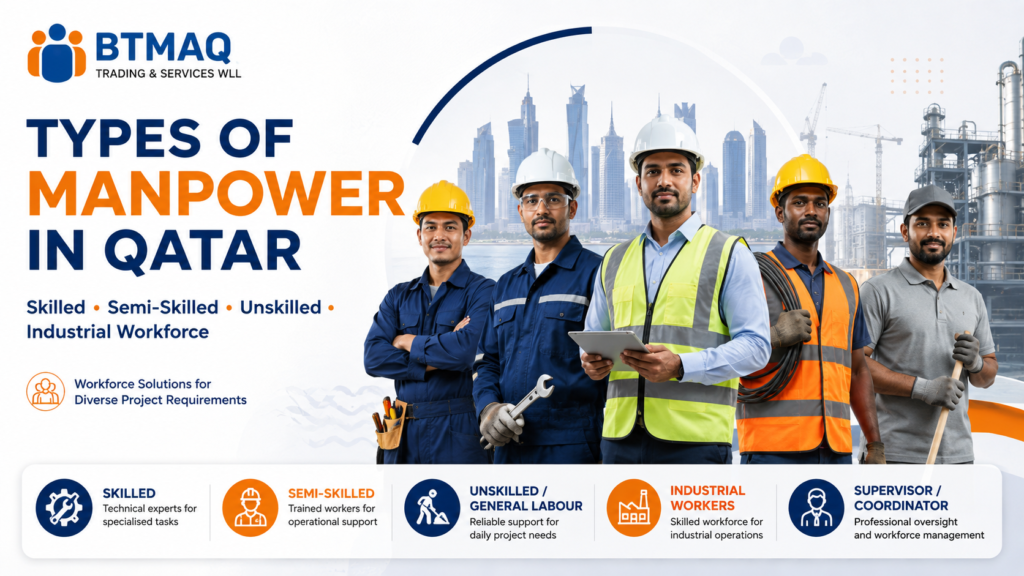
Skilled Manpower
Skilled manpower generally includes workers who require specific technical experience, trade knowledge, professional training or recognised qualifications for their role.
Examples may include:
- Electricians
- Welders
- HVAC technicians
- Plumbers
- Equipment operators
- Mechanical technicians
- MEP trades
- Supervisory personnel
The exact qualification requirements depend on the job and project.
Where a role requires specific trade tests, certifications or site approvals, these should be stated during the manpower request.
Semi-Skilled Manpower Supply
Semi-Skilled Manpower Supply supports roles that require practical experience and task-specific capability but may not require the same level of formal technical qualification as specialised trades.
Semi-skilled personnel can support:
- Construction activity
- Maintenance teams
- Industrial operations
- Facility-management work
- Material handling
- MEP support
- Site preparation
- Production operations
The term “semi-skilled” should not be used as a generic label for every worker.
The client should explain the actual work.
For example, a worker with experience assisting plumbing teams may not automatically be suitable for electrical support or industrial production.
Matching experience to the assignment remains important.
Unskilled Manpower Supply
Unskilled Manpower Supply generally refers to general workers performing roles that do not require a specialised technical trade.
Possible requirements include:
- General labour
- Helpers
- Material handling
- Loading and unloading
- Site support
- Cleaning assistance
- Basic operational support
Although these roles may not require specialised qualifications, they still require appropriate briefing, supervision and safety awareness.
A general worker assigned to an active construction or industrial site should understand the relevant site rules and should not perform specialist duties outside the assigned role.
Industrial Manpower Supply
Industrial Manpower Supply supports factories, workshops, plants, production operations and other industrial environments.
Industrial manpower requirements may involve:
- Production helpers
- Technicians
- Mechanical personnel
- Fabrication support
- Material handlers
- Maintenance support
- Operators
- Cleaning personnel
- Supervisors
Industrial environments may have stricter safety and operational controls than ordinary workplaces.
When requesting manpower, businesses should identify any requirements relating to plant induction, PPE, permits, technical experience, shift patterns or specialised safety training.
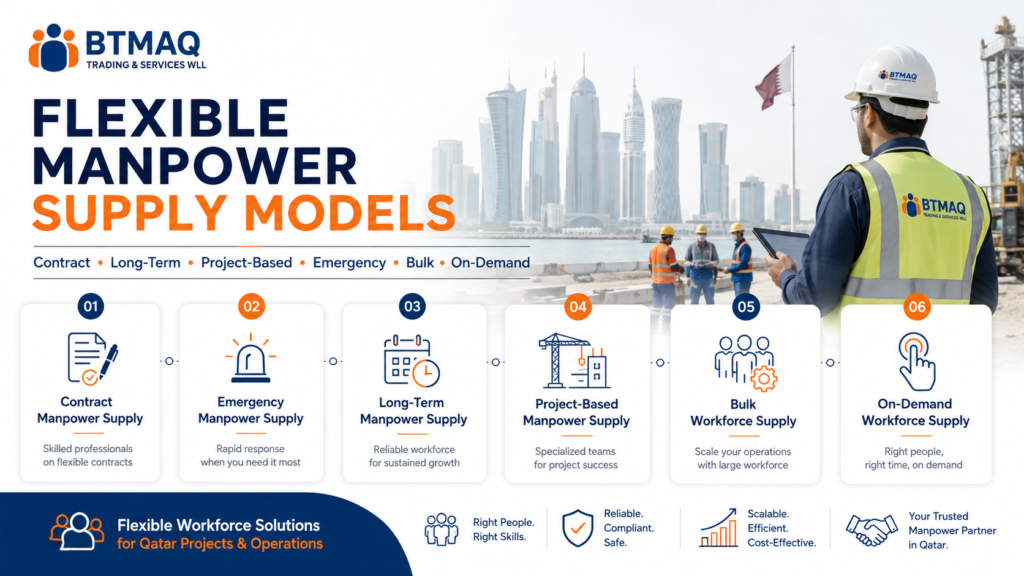
Flexible Manpower Supply Models in Qatar
Not every business requires manpower under the same commercial or operational arrangement.
The correct model depends on workload, project duration, workforce quantity and how predictable the requirement is.
Contract Manpower Supply
Contract Manpower Supply is suitable when a business needs workers for an agreed period or contract scope.
The arrangement may cover several months, a project phase or a longer operational requirement.
Businesses should define:
- Job categories
- Quantity
- Contract duration
- Work location
- Working hours
- Shift requirements
- Overtime arrangements
- Transportation
- Supervision
- Replacement procedures
Contract manpower can be particularly useful when a business knows that it needs additional workforce capacity but does not want every position to become permanent internal headcount.
Emergency Manpower Supply
Unexpected workforce shortages can affect operations quickly.
Emergency Manpower Supply may be required when:
- Workers become unexpectedly unavailable
- A project schedule changes
- Workload increases suddenly
- A new urgent scope is added
- A deadline requires additional manpower
- A client requests accelerated execution
Emergency requirements are more difficult to fulfil than planned requirements because worker availability, documentation, transportation and job matching must be coordinated within a shorter timeframe.
Businesses can improve the process by providing complete details immediately.
A request stating “20 workers urgently required” is less useful than a request explaining the role, quantity, location, start time, working hours, duration and required experience.
Long-Term Manpower Supply
Long-Term Manpower Supply is suitable for businesses that require additional workforce for an extended period while maintaining a flexible supply arrangement.
Examples may include:
- Facility-management contracts
- Long construction projects
- Industrial operations
- Maintenance contracts
- Hospitality operations
- Infrastructure projects
Long-term requirements should consider continuity.
Where workers remain on a project for months, businesses often benefit from keeping stable teams because workers become familiar with the location, procedures and supervisor expectations.
The agreement should also address workforce replacement, attendance management, leave coverage and any changes in required headcount.
Project-Based Manpower Supply
Project-Based Manpower Supply aligns workforce deployment with a specific project or scope of work.
The project may have clearly defined stages.
For example:
- Site preparation
- Main execution
- Installation
- Testing
- Finishing
- Handover
Each phase can require different manpower categories and quantities.
A strong project manpower plan therefore forecasts workforce demand instead of treating manpower as one fixed number from start to finish.
Project managers should review the manpower requirement as the schedule changes.
This helps reduce situations where a project has too many workers during low-demand periods or too few workers during critical phases.
Bulk Workforce Supply
Large projects may require dozens or even hundreds of workers across several categories.
Bulk Workforce Supply involves coordinating larger manpower quantities while maintaining clear role allocation, scheduling and mobilisation.
The challenge is not simply finding a large number of people.
Bulk deployment also requires planning for:
- Worker categories
- Team structure
- Supervisors
- Transportation
- Reporting locations
- Attendance
- Documentation
- Shift allocation
- Replacement
- Site induction
Large requirements should therefore be communicated well in advance wherever possible.
A phased mobilisation may also be more practical than deploying every worker at the same time.
On-Demand Workforce Supply
On-Demand Workforce Supply provides flexibility where businesses cannot always predict their exact workforce requirement far in advance.
Possible use cases include:
- Variable operational workload
- Business peaks
- New short-duration assignments
- Maintenance activity
- Project schedule changes
- Temporary capacity gaps
The effectiveness of on-demand manpower depends heavily on the availability of workers in the required category.
Businesses should avoid assuming that every trade can be supplied instantly.
Specialist positions can require more screening and verification than general support roles.
Labour Hire Services
Labour Hire Services allow businesses to obtain workers for defined operational requirements without handling every element of worker sourcing individually.
The commercial and management structure can vary, so the agreement should clearly define:
- Who supervises daily work
- Who records attendance
- Who approves overtime
- Who provides tools
- Who provides PPE
- Who arranges transportation
- Who manages employment administration
- How replacement is handled
Clear responsibilities reduce disputes once workers arrive on site.
The client should also ensure that workers are only assigned tasks appropriate to their role and level of competence.
Workforce Solutions
The term Workforce Solutions is broader than simply supplying workers.
A workforce solution begins with the client’s operational problem.
For example:
“We need to increase output for three months.”
or:
“We have a new project beginning next month and need 40 additional workers across four job categories.”
A workforce plan can then consider:
- Workforce quantity
- Skill mix
- Contract duration
- Shift pattern
- Deployment schedule
- Supervisory structure
- Replacement planning
- Workforce scaling
The purpose is to match people to business demand rather than treating manpower as a simple commodity.
Facility Management Manpower
Facility Management Manpower supports organisations responsible for the operation and maintenance of commercial, residential, hospitality, industrial and institutional properties.
Roles can include:
- Cleaners
- Helpers
- Maintenance personnel
- HVAC technicians
- Electricians
- Plumbers
- General technicians
- Supervisors
- Operational support staff
Facility-management contracts often require consistent service over extended periods.
For this reason, attendance, workforce continuity, replacement planning and shift management can be particularly important.
Clients should specify whether workers are required at one facility or across multiple locations.
Industries That Depend on Manpower Supply in Qatar
Manpower requirements vary significantly between industries.
A provider that understands those differences can match workers more effectively.

Construction
Construction projects may require skilled trades, semi-skilled workers, operators, helpers, general labour and supervisory staff.
Workforce requirements change as the project progresses from civil works to MEP, finishing and handover.
Oil and Gas
Oil and gas projects can require workers with specific technical experience, safety training, site approvals or certifications.
Businesses should identify project-specific requirements before requesting personnel.
MEP
Mechanical, electrical and plumbing operations may require electricians, plumbers, HVAC personnel, technicians and helpers.
Skill verification becomes particularly important for technical roles.
Businesses requiring MEP manpower may need electricians, plumbers, HVAC personnel, technicians and helpers depending on the project scope.
Industrial Operations
Factories, workshops and plants may use technicians, production workers, operators, helpers, maintenance personnel and material handlers.
Shift patterns should be communicated clearly.
Infrastructure
Road, civil and infrastructure projects can involve a combination of operators, tradespeople, helpers and general workers.
Site location and transportation may be important planning factors.
Facility Management
Facility operations need stable teams covering cleaning, maintenance and technical support.
Many contracts operate across multiple shifts or properties.
Hospitality
Hotels, catering operations and hospitality businesses may require housekeeping, F&B, kitchen, banquet and general support personnel.
Demand may increase during events, peak seasons or new property openings.
Cleaning
Cleaning manpower can support offices, commercial facilities, industrial sites, hospitality operations and post-construction work.
Specialised cleaning roles may require additional training or equipment.
Logistics and Warehousing
Logistics operations can require loaders, handlers, warehouse helpers, operators, dispatch support and other workforce categories.
These industries may experience strong demand during peak periods.
BTMAQ’s existing published service coverage includes these major workforce categories and industries across Qatar.
How the Manpower Supply Process Works
A structured manpower supply process can reduce delays and improve workforce matching.
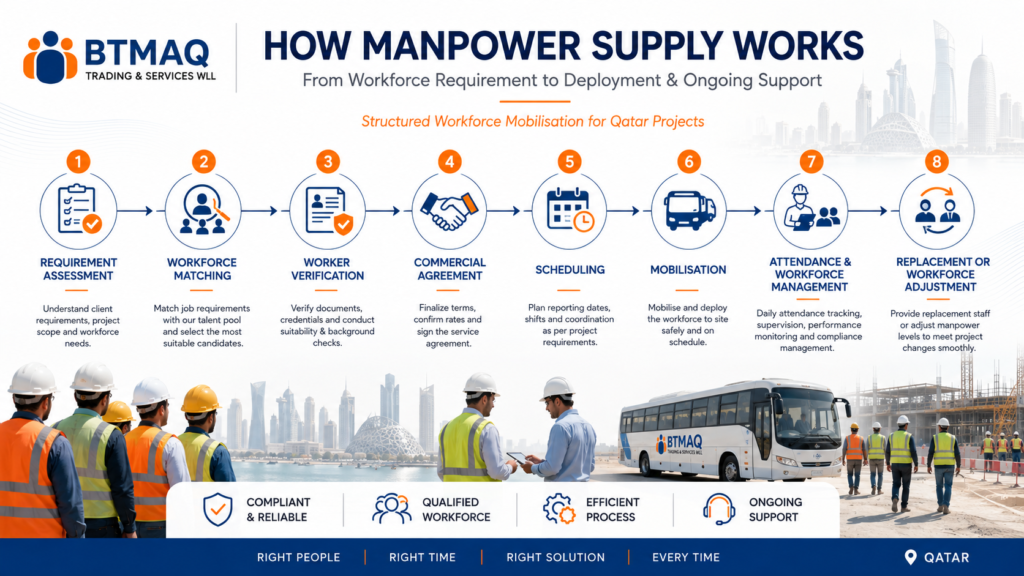
1. Requirement Assessment
The client explains:
- Required job roles
- Number of workers
- Project or operation
- Location
- Start date
- Duration
- Working hours
- Required experience
- Certifications if applicable
This stage is essential.
The more accurate the requirement, the easier it is to identify suitable workers.
2. Workforce Matching
Available workers are compared with the requirement.
For technical roles, relevant experience and qualifications should be considered.
For general labour, physical suitability and relevant work experience may be more important.
3. Worker Verification
Depending on the role and project, verification may involve reviewing:
- Identity documents
- Employment documentation
- Experience
- Trade capabilities
- Qualifications
- Training
- Site-specific requirements
4. Commercial Agreement
The client and provider confirm the commercial scope.
This should cover:
- Rate structure
- Working hours
- Overtime
- Transport
- Meals where applicable
- PPE
- Supervision
- Contract duration
- Replacement
- Payment terms
5. Scheduling
Workers receive reporting instructions and deployment details.
For larger teams, the schedule may include different reporting points or shifts.
6. Mobilisation
Workers report to the agreed location.
Large projects may use phased mobilisation to match workforce numbers to the project schedule.
7. Attendance and Workforce Management
Attendance should be recorded consistently.
The process should also define how lateness, absence, overtime and shift changes are communicated.
8. Replacement or Workforce Adjustment
Operational requirements can change.
Businesses may need to:
- Increase workforce
- Reduce workforce
- Replace unavailable workers
- Change job categories
- Extend the contract
These procedures should be discussed before problems occur.
BTMAQ’s published process similarly describes requirement analysis, worker shortlisting and verification, documentation, mobilisation and ongoing support as core deployment stages.
Fast Workforce Deployment in Qatar
Fast Workforce Deployment is important when project schedules leave little room for recruitment delays.
However, speed should not come at the expense of workforce suitability or documentation.
The fastest manpower requests are usually the clearest ones.
A client should provide:
- Exact role
- Number of workers
- Required experience
- Project location
- Start date
- Contract duration
- Working hours
- Shift
- Transportation arrangements
- Required documents or certifications
- Site-specific requirements
Worker availability is another major factor.
General labour may be easier to organise quickly than a highly specialised technical role requiring specific credentials.
Businesses should therefore distinguish between:
Urgent requirement and unrealistic requirement.
Early communication remains the best way to improve mobilisation.
For larger projects, the client can also provide a forecast several weeks or months ahead so that manpower planning can begin before the final deployment date.
Manpower Documentation and Labour Compliance in Qatar
Manpower planning must take place within the applicable Qatar labour framework.

Qatar Labour Law No. 14 of 2004 regulates major employment matters, including working hours and overtime for workers covered by its provisions. Article 73 sets maximum ordinary working hours at 48 hours per week and eight hours per day, with reduced ordinary hours during Ramadan. Article 74 addresses additional working hours and related compensation.
This matters for manpower projects because extended operating hours should be planned through proper shifts and overtime arrangements rather than simply assuming workers can remain on site indefinitely.
Another important element is wage administration.
Qatar’s Wage Protection System applies to workers covered by the relevant Labour Law framework. The Ministry of Labour’s WPS decision states that employers must transfer worker wages through financial institutions within the required period following the due date.
Beyond working hours and wages, businesses should consider:
- Valid worker documentation
- Site access requirements
- Job-specific qualifications
- Medical or fitness requirements where applicable
- Health and safety rules
- PPE
- Induction
- Permit requirements
- Client-specific procedures
The exact requirements vary according to the industry and job.
For example, a general warehouse helper and a worker entering a specialised industrial site may face very different induction and documentation requirements.
Clients and manpower providers should therefore confirm responsibilities before deployment.
How to Calculate Your Manpower Requirement
A common workforce-planning mistake is starting with a number instead of the workload.
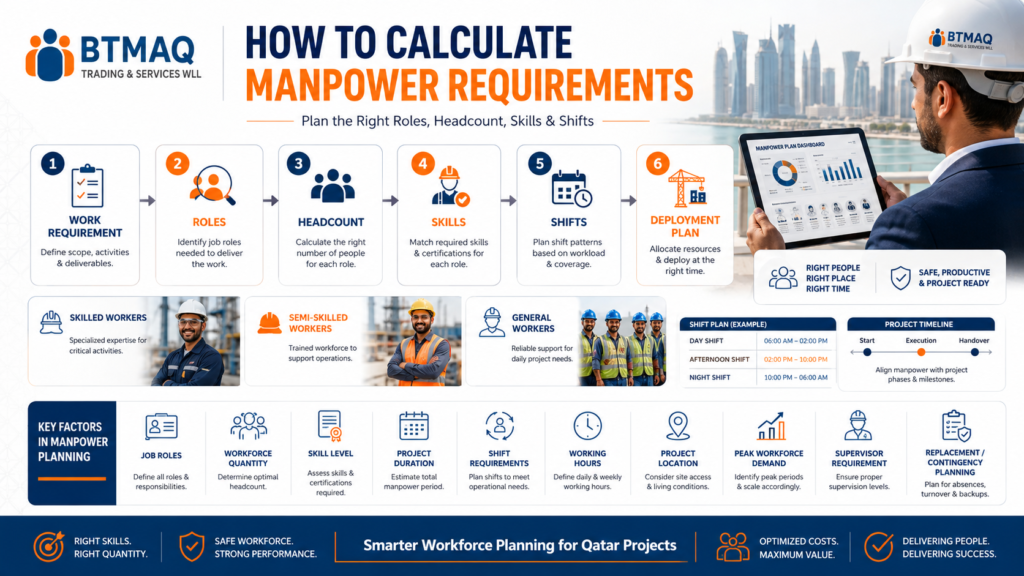
Rather than asking:
“How many workers should we hire?”
start by asking:
“What work must be completed, during what period, and how much workforce capacity does it require?”
Consider the following factors.
| Planning Factor | What to Determine |
| Job roles | Which workers are actually required? |
| Quantity | How many workers are needed per role? |
| Skill level | Skilled, semi-skilled or general? |
| Duration | Days, months or long term? |
| Shifts | Day, night or multiple shifts? |
| Workload | Normal or peak requirement? |
| Location | Where will workers report? |
| Supervision | Are team leaders required? |
| Transport | Who will arrange mobilisation? |
| Contingency | Is replacement capacity required? |
Start With the Work Breakdown
Divide the project into functions.
For example, a construction project may separately require:
- Masons
- Electricians
- Plumbers
- Helpers
- General labour
- Supervisors
Do not combine everything into “50 workers.”
Calculate by Shift
A requirement of 20 people on a single shift is different from a requirement to maintain 20 people on site continuously across multiple shifts.
Identify Peak Periods
Projects do not always require the same workforce every day.
Forecast the highest-demand periods.
Include Supervision
Larger teams may require foremen, supervisors or coordinators.
Plan for Change
Project schedules can move.
A good manpower plan includes a process for increasing or reducing workforce where contract terms allow.
What Determines Manpower Supply Cost in Qatar?
There is no single rate that applies to every manpower requirement.
Pricing depends on the complete scope.
Worker Category
Specialist trades and technical personnel may have different cost structures from general labour.
Quantity
A large workforce can create additional mobilisation, transportation and supervisory requirements.
Contract Duration
The commercial structure may differ between a short requirement and a long-term deployment.
Working Hours
Overtime, night work and extended schedules can affect costs.
Transportation
The location and reporting time may require dedicated transport.
Accommodation and Other Services
Commercial arrangements may differ depending on which services are included.
Certification and Experience
Certain technical workers may require qualifications, trade tests or specific project experience.
Urgency
Last-minute mobilisation can create greater logistical pressure.
Because your site already has a dedicated manpower-cost guide, the best approach here is to understand the main factors rather than treat one generic rate as applicable to every role.
Manpower Supply vs Direct Recruitment
Both models can be useful, but they solve different workforce problems.
| Factor | Manpower Supply | Direct Recruitment |
| Best suited for | Flexible/project workforce | Permanent internal roles |
| Workforce duration | Can be fixed or flexible | Usually longer term |
| Scaling | Easier to increase/reduce under agreed terms | Requires hiring or termination processes |
| Recruitment process | Provider supports workforce sourcing | Company recruits directly |
| Project use | Strong fit | Depends on project duration |
| Mobilisation | Can be faster where workers are available | Usually requires a full hiring cycle |
| Workforce administration | Depends on supply agreement | Managed directly by employer |
| Flexibility | Higher | Lower for short-term changes |
Neither model is automatically better.
A business building a permanent management team may prefer direct recruitment.
A contractor that needs 60 additional workers for a defined project phase may find manpower supply more practical.
Many organisations use both models simultaneously.
Permanent employees manage core operations while supplementary manpower supports changing project demand.
How to Request Manpower Supply in Qatar
The quality of a manpower proposal depends heavily on the quality of the requirement submitted.
Before contacting a provider, prepare the following information.
Job Roles
List every required category separately.
For example:
- 10 electricians
- 8 plumbers
- 15 helpers
- 20 general workers
- 2 supervisors
This is much better than stating “55 workers.”
Required Quantity
Provide exact numbers where possible.
If numbers may change, explain the expected range.
Project Location
Specify the actual site or operating area.
Transportation planning depends on location.
Start Date
State when workers need to report.
Duration
Explain whether the manpower is required for:
- Several days
- Several weeks
- Several months
- Long-term operations
Working Hours and Shifts
Provide normal hours and expected shift arrangements.
Experience
Identify any required trade or industry experience.
Certifications
State required qualifications or project approvals.
PPE and Tools
Confirm whether these will be provided by the client or included in the supply arrangement.
Transportation
Clarify who will arrange worker transport.
Supervision
Large teams may require dedicated supervisory personnel.
Providing these details at the beginning makes quotations easier to compare and reduces unnecessary revisions.
Why Choose BTMAQ for Manpower Supply in Qatar?
BTMAQ Trading & Services WLL positions its workforce services around skilled, semi-skilled and unskilled manpower for multiple sectors across Qatar.
According to BTMAQ’s currently published company information, the business states that it is licensed and Ministry of Labour approved, operates WPS-compliant workforce management, has more than 10 years of operational experience and has deployed more than 500 workers.
Its published manpower categories include:
- Skilled workers
- Semi-skilled workers
- Unskilled workers
- Technical manpower
- General labour
- Project workforce
Industry coverage includes:
- Construction
- Oil and gas
- Industrial operations
- MEP
- Logistics
- Warehousing
- Hospitality
- Cleaning
- Facility management
- Infrastructure
BTMAQ also publishes support for short-term, long-term, project-based, emergency and bulk manpower requirements.
The appropriate workforce arrangement depends on each client’s requirement.
Businesses should provide the job roles, quantity, location, project duration, working hours and any technical or compliance requirements so the manpower requirement can be evaluated accurately.
Frequently Asked Questions About Manpower Supply in Qatar
What is Manpower Supply in Qatar?
Manpower Supply in Qatar refers to providing businesses with workers according to defined operational, project or contract requirements. Workforce can include skilled, semi-skilled and general personnel depending on the assignment.
What types of manpower can businesses request?
Requirements can include technical trades, semi-skilled personnel, industrial workers, helpers, general labour, facility-management staff, hospitality personnel and other project-support roles.
Can manpower be supplied for a project instead of permanently?
Yes. Project-based manpower arrangements are designed around a defined project, scope or duration.
What is Contract Manpower Supply?
Contract manpower supply involves providing agreed workers for a defined contract period under specified commercial and operational terms.
What is Semi-Skilled Manpower Supply?
Semi-skilled manpower refers to personnel who have practical work experience and task-specific capability but may not require the same level of specialist qualification as skilled trades.
Can businesses request Unskilled Manpower Supply?
Yes. General labour and support workers can be used for appropriate non-specialist tasks depending on the project requirement.
What is Bulk Workforce Supply?
Bulk workforce supply refers to coordinating larger manpower quantities, often across multiple job categories, for projects or operations requiring significant headcount.
What is On-Demand Workforce Supply?
On-demand workforce supply is used when businesses require additional manpower based on changing operational demand rather than a completely fixed long-term headcount.
How quickly can manpower be deployed?
Deployment time depends on worker availability, quantity, role, documentation, project location, client requirements and approvals. Businesses should provide complete requirements as early as possible.
What affects manpower supply cost in Qatar?
Important factors include worker category, quantity, contract duration, working hours, overtime, transportation, supervision, certifications, accommodation arrangements where applicable and mobilisation urgency.
What documents should be checked before deployment?
Requirements vary by role and project but can include identity and employment documents, qualifications, training records, medical or site documentation and other client-specific requirements.
How should companies calculate manpower requirements?
Businesses should calculate manpower based on workload, job roles, project phases, shifts, duration, skill levels and peak-demand periods rather than using one overall headcount estimate.
Can workforce numbers change during a project?
Workforce may be increased, reduced or adjusted depending on operational requirements and the terms of the manpower agreement.
Which industries use manpower supply services?
Construction, oil and gas, industrial operations, MEP, infrastructure, facility management, logistics, warehousing, hospitality and cleaning are among the sectors that commonly require flexible workforce support.
What information is needed for a manpower quotation?
Provide the required roles, quantity, location, start date, duration, working hours, shifts, experience requirements, certifications, transport arrangements, PPE requirements and supervision details.
Plan the Right Manpower Supply for Your Qatar Project
Successful manpower planning is not about supplying the largest possible number of workers.
It is about providing the right workforce at the right stage of the project.
A well-planned Manpower Supply in Qatar requirement should define job categories, skill levels, workforce quantity, project duration, shifts, location and responsibilities before deployment begins.
Businesses should also consider how manpower demand may change as the project progresses.
Contract manpower may suit a defined requirement. Long-term manpower may support ongoing operations. Project-based manpower can follow construction or industrial schedules. Bulk or on-demand workforce arrangements can help businesses respond to changing capacity requirements.
The correct model depends on the operation.
BTMAQ Trading & Services WLL provides manpower solutions for businesses across Qatar based on role, quantity, duration and project requirements.
For an accurate manpower proposal, prepare your workforce requirement before requesting a quotation.
Request Manpower Supply in Qatar
Contact BTMAQ Trading & Services WLL to discuss your manpower requirement.
Phone / WhatsApp: +974 66246371
Email: info@manpoweragencyinqatar.com
Location: Doha, Qatar
Share your required job categories, workforce quantity, project location, start date and expected duration so the manpower requirement can be reviewed.