








Factories, workshops, plants and production facilities often require a workforce that understands the environment in which industrial work takes place. Depending on the operation, a business may need production helpers, technicians, mechanical personnel, material handlers, operators, maintenance support or supervisors.
This is where Industrial Manpower Supply becomes relevant.
Industrial manpower is not simply about supplying a large number of workers. The workforce needs to match the actual role, operating environment, shift pattern and site requirements. A production facility may have very different workforce needs from a fabrication workshop, while a plant may require additional preparation before workers can begin their assignments.
For businesses in Qatar, defining these requirements clearly can make it easier to request suitable industrial personnel.
This guide explains what industrial manpower supply covers, the types of workers businesses may require, how to match roles to the right workforce, and what to consider before requesting industrial manpower.
What Is Industrial Manpower Supply?
Industrial manpower supply refers to providing workers for factories, workshops, plants, production operations and other industrial environments according to defined workforce requirements.
The workforce may include technical, operational, maintenance, material-handling, cleaning and supervisory personnel depending on the nature of the industrial operation.
The important point is that industrial manpower should be defined around the work.
A request for:
“20 industrial workers”
does not explain enough.
A better requirement identifies the actual roles, such as production helpers, material handlers, technicians or maintenance support, together with the quantity, location, working schedule and experience required.
That gives a manpower provider a clearer basis for matching workers to the industrial assignment.
Where Is Industrial Manpower Used?
Industrial manpower can support several types of operating environments.
Factories
Factories may require a combination of production, maintenance, material-handling and general support personnel.
The workforce mix depends on the production activities and how the facility operates.
Workshops
Workshops can require technical and mechanical personnel alongside workers who support material movement, preparation and general operations.
The actual job requirements should be defined before workers are selected.
Plants
Plant environments can involve more structured operational requirements and may require specific preparation before workers begin their assignments.
Depending on the role, requirements can include induction, PPE, permits, technical experience, shift patterns or other site conditions.
Production Operations
Production environments may require operators, production helpers, maintenance support, material handlers and supervisors.
Workforce requirements can change according to production schedules and operational demand.
Other Industrial Environments
Industrial manpower can also support other environments where businesses need workers for defined technical, operational or general support activities.
The exact workforce should always be determined by the actual task and operating conditions rather than by a generic industry label.
Types of Industrial Manpower
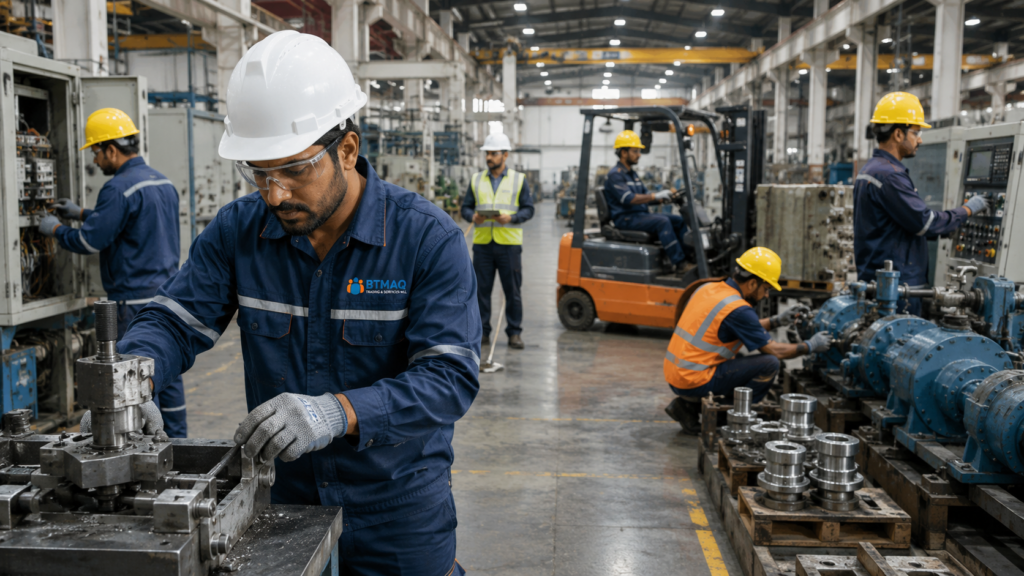
Different industrial functions require different workforce profiles.
Production Helpers
Production helpers can support defined production activities and other appropriate non-specialist tasks.
Their exact responsibilities should be established before deployment.
Technicians
Technicians may be required for roles involving specific technical knowledge or practical capability.
The required experience should be clearly defined because not every technician is automatically suitable for every industrial environment.
Mechanical Personnel
Mechanical personnel can support industrial mechanical activities according to the requirements of the assignment.
Where specialist technical capability is required, the role should be specified accordingly.
Fabrication Support
Fabrication operations may require workers who can support defined fabrication activities.
The workforce requirement should clearly distinguish support activities from specialist technical responsibilities.
Material Handlers
Material handlers can support the movement and handling of materials within the industrial environment.
The nature of the materials, work area and actual duties should be understood before assigning workers.
Maintenance Support
Industrial maintenance teams may require additional personnel to support defined maintenance-related activities.
The required level of technical experience should be stated when requesting workers.
Operators
Industrial operations may require operators for particular equipment or processes.
The business should identify the actual operating role and any relevant experience or requirements.
Cleaning Personnel
Industrial facilities may also require cleaning personnel to support facility or production-area cleanliness.
Where specialised cleaning is required, the relevant training and equipment requirements should be considered.
Supervisors
Larger or more structured industrial teams may require supervisory personnel to coordinate workers and maintain clear reporting lines.
These role categories are based on the industrial workforce requirements identified in the source brief.
How to Choose the Right Industrial Workforce
The worker category should come after the job requirement is understood.
Start by asking:
What work needs to be completed?
Then consider:
What experience is required?
Next:
What technical capability is needed?
Then:
What working environment and site conditions apply?
This approach helps prevent a common mistake: selecting workers based only on a job title.
For example, an industrial business may need maintenance support, but the exact experience required can differ depending on the equipment, environment and responsibilities involved.
A more useful framework is:
Task → Experience → Capability → Workforce Match
The goal is not simply to fill the headcount. It is to find workers whose experience fits the actual industrial assignment.
What Makes Industrial Workforce Requirements Different?

Industrial environments can have requirements that need to be understood before workers are deployed.
These may include:
- Plant induction
- PPE requirements
- Permit requirements
- Technical experience
- Shift patterns
- Specialised safety training
Not every worker or every industrial assignment will require all of these.
The requirements can vary according to the plant, role and project conditions. That is why they should be identified during the workforce-planning stage rather than assumed afterward.
A general support worker, for example, may have different preparation requirements from a technician working in a more controlled industrial environment.
Industrial Manpower by Workforce Function
Looking at industrial workforce by function can make planning easier.
Production
Production helpers and operators may support production activities according to the actual process.
Technical
Technicians and mechanical personnel may support technical and maintenance-related requirements.
Fabrication
Fabrication support workers can assist with defined fabrication activities where appropriate.
Material Handling
Material handlers can support the movement and handling of materials within the operation.
Maintenance
Maintenance support personnel can work alongside the relevant maintenance team according to their assigned responsibilities.
Facility and General Support
Cleaning personnel and other general support workers can support non-specialist operational needs.
Supervision
Supervisors can help coordinate larger teams and maintain reporting structures.
This functional structure is more useful than treating every industrial worker as part of one general category.
Shift Planning for Industrial Operations
Industrial operations often need clear working schedules.
Depending on the facility, workforce requirements may involve:
- Day shifts
- Night shifts
- Multiple shifts
- Defined reporting times
When requesting manpower, businesses should explain the expected schedule rather than only providing a total headcount.
For example, a requirement for workers across several shifts is different from a requirement for the same number of workers on a single shift.
Shift patterns should therefore be defined before deployment so the workforce can be planned around the actual operating schedule.
This article does not attempt to provide a universal industrial shift formula because the correct workforce depends on the operation.
Safety and Site Readiness for Industrial Workers
Industrial workers may need to meet site-specific readiness requirements before beginning an assignment.
Depending on the role and environment, businesses may need to consider:
Plant Induction
Workers may need to understand the site’s procedures and operating environment before beginning work.
PPE
The appropriate personal protective equipment should be identified according to the assignment and site requirements.
Permits
Some industrial activities may involve permit-related requirements. These should be identified before deployment where applicable.
Technical Experience
Technical roles may require relevant industrial experience.
Specialised Safety Training
Certain assignments may require additional safety preparation depending on the work and site.
These requirements should not be treated as identical for every industrial worker. The exact needs depend on the role and environment.
For current regulatory or labour-related requirements in Qatar, businesses should rely on official authorities rather than assuming that a generic industrial checklist applies to every assignment. Qatar Ministry of Labour
What Should Businesses Check Before Requesting Industrial Manpower?
Before contacting a manpower provider, it helps to answer a few basic questions.
What Are the Required Roles?
Identify technicians, operators, helpers, material handlers, maintenance personnel or other categories separately.
How Many Workers Are Needed?
Provide the quantity required for each role.
What Experience Is Required?
Describe the relevant industrial experience where applicable.
Where Will Workers Be Deployed?
Provide the industrial site or operating location.
When Are Workers Needed?
State the expected start date and duration.
What Shift Pattern Applies?
Mention day, night or multiple shifts.
What Site Requirements Apply?
Identify relevant induction, PPE, permits or training requirements.
Is Supervision Required?
Explain whether supervisors or other coordination personnel are part of the workforce requirement.
These details make it easier to evaluate the actual requirement instead of relying on a generic request for industrial workers.
How to Request Industrial Manpower in Qatar

A clear request should explain both the workforce and the working environment.
Required Roles
List each workforce category separately.
Quantity
State the number of people required for each role.
Experience
Mention relevant industrial experience.
Location
Provide the actual site or operating location.
Start Date
State when workers should report.
Duration
Explain how long the workforce is expected to be required.
Working Hours and Shifts
Provide normal hours and shift arrangements.
Technical Requirements
Mention relevant technical capabilities or experience.
Site Requirements
Include plant induction, PPE, permit or specialised training requirements where applicable.
This level of detail gives the manpower provider a much clearer basis for evaluating and matching the requirement.
What Affects Industrial Manpower Supply Cost?
There is no single rate for every industrial manpower requirement.
Cost can vary according to:
- Worker category
- Technical experience
- Number of workers
- Contract duration
- Working hours and shifts
- Work location
- Transportation
- Supervision
- Relevant qualifications or certifications
- Additional site requirements
For example, a request for general production support at one location may have a different commercial scope from a technical maintenance workforce operating across multiple shifts.
This is why businesses should compare the complete workforce requirement and service scope, not just a headline manpower rate.
Common Industrial Manpower Planning Mistakes
Requesting Only a Headcount
“Need 50 industrial workers” does not explain the actual workforce requirement.
Not Defining the Work
Workers should be matched to the actual tasks they will perform.
Ignoring Shift Patterns
Industrial operations may operate across different schedules, so shift requirements should be explained early.
Treating All Industrial Workers as Interchangeable
A technician, material handler, operator and production helper have different responsibilities.
Leaving Site Requirements Until Later
Plant induction, PPE, permits and other applicable requirements should be identified before deployment.
Ignoring Technical Experience
A worker may be available but still not be suitable for a specific industrial assignment.
Planning Only for the Initial Headcount
Operational requirements may change, so businesses should understand how workforce adjustments will be handled.
Why Choose BTMAQ for Industrial Manpower Supply in Qatar?
BTMAQ currently publishes skilled, semi-skilled and unskilled workforce solutions in Qatar and identifies industrial operations among its service areas. Its published manpower coverage also includes technical workers, general labour and other workforce categories relevant to industrial requirements. (manpoweragencyinqatar.com)
For broader manpower information, you can review the Manpower Supply in Qatar guide.
BTMAQ also publishes wider manpower services in Qatar across multiple workforce categories and industries.
The exact industrial workforce requirement should still be assessed according to the role, quantity, experience, location, schedule and site conditions.
Frequently Asked Questions
What is Industrial Manpower Supply?
Industrial Manpower Supply refers to providing workers for factories, workshops, plants, production operations and other industrial environments according to defined workforce requirements.
What types of workers are used in industrial operations?
Industrial workforce requirements can include production helpers, technicians, mechanical personnel, fabrication support workers, material handlers, maintenance support, operators, cleaning personnel and supervisors.
Which industries use industrial manpower?
Industrial manpower can support factories, workshops, plants, production operations and other industrial environments.
Can industrial manpower include maintenance workers?
Yes. Maintenance support is one of the workforce functions identified for industrial operations. The exact technical capability required depends on the assignment.
Can industrial manpower be supplied for shift-based operations?
Yes. Shift patterns should be identified when requesting the workforce so the requirement can be planned around the actual operating schedule.
Do industrial workers need plant induction?
Requirements can vary by plant, role and assignment. Where plant induction is applicable, it should be identified before deployment.
Are PPE and permits required for all industrial workers?
Not necessarily. PPE, permits and other site requirements depend on the role, environment and assignment.
What information should I provide when requesting industrial manpower?
Provide the required roles, quantity, experience, location, start date, duration, working hours, shifts and any applicable technical or site requirements.
What affects industrial manpower supply cost in Qatar?
Cost can vary according to worker category, experience, quantity, duration, shifts, location, transportation, supervision and other assignment requirements.
Plan the Right Industrial Workforce
Industrial manpower planning starts with understanding the work.
A factory, workshop or plant may need several different workforce functions, from production helpers and operators to technicians, maintenance personnel, material handlers and supervisors.
The best approach is to define the role, experience, quantity, location, schedule and site requirements before requesting manpower.
The objective is not simply to fill an industrial workforce quota. It is to match the right people to the right operational requirements.
Request Industrial Manpower in Qatar
Need workers for a factory, workshop, plant or other industrial operation?
Share your required roles, workforce quantity, location, experience requirements, start date, duration and shift pattern with BTMAQ Trading & Services WLL so the requirement can be reviewed according to the actual assignment.
Phone / WhatsApp: +974 66246371
Email: info@manpoweragencyinqatar.com
Location: Doha, Qatar