





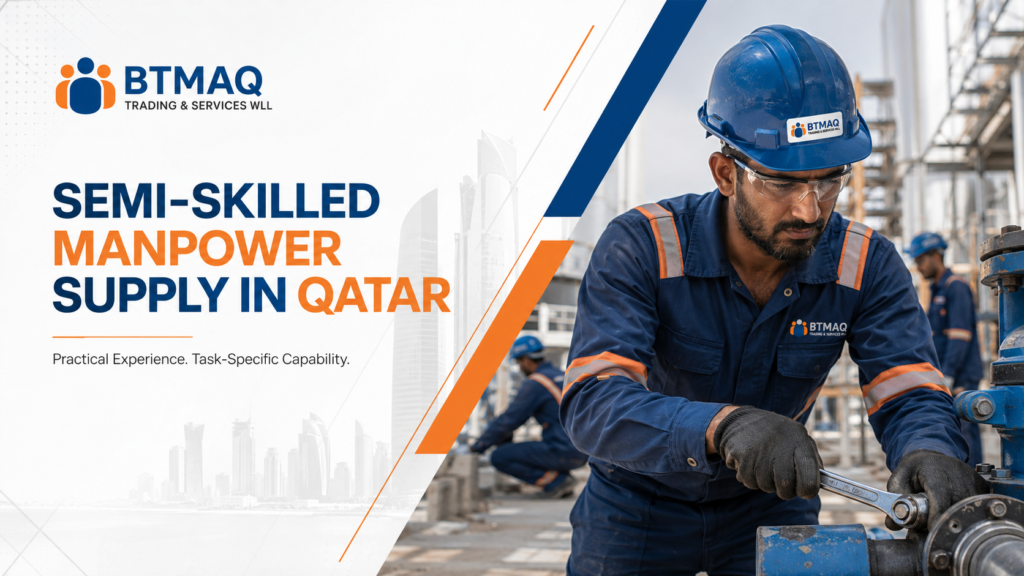
Not every workforce requirement needs a highly specialised trade professional. At the same time, general labour may not have the practical experience needed for certain tasks. This is where Semi-Skilled Manpower Supply can fit into a workforce plan.
Semi-skilled personnel generally have practical work experience and task-specific capability, while the level of formal technical qualification can differ from that required for specialised trades. The important point is not the label itself, but whether a worker’s actual experience and capability match the work they will perform.
For businesses in Qatar, this distinction matters when planning manpower for construction, maintenance, industrial operations, facility management, material handling, MEP support, site preparation and production-related work.
This guide explains what semi-skilled manpower means, where it can be used, how it differs from skilled and unskilled workers, and what businesses should consider before requesting a workforce.
What Is Semi-Skilled Manpower?
Semi-skilled manpower refers to personnel who have practical experience and task-specific capability for the work they are assigned to perform.
The category sits between highly specialised technical roles and general non-specialist support work. However, it should not be treated as a universal label that automatically tells you everything about a worker.
Two workers may both be described as semi-skilled while having very different experience.
One may have experience supporting maintenance activities, while another may have worked in material handling or site preparation. Their suitability depends on the actual tasks involved.
That is why the workforce requirement should begin with the job itself, rather than simply asking for a certain number of semi-skilled workers.
Semi-Skilled vs Skilled vs Unskilled Manpower
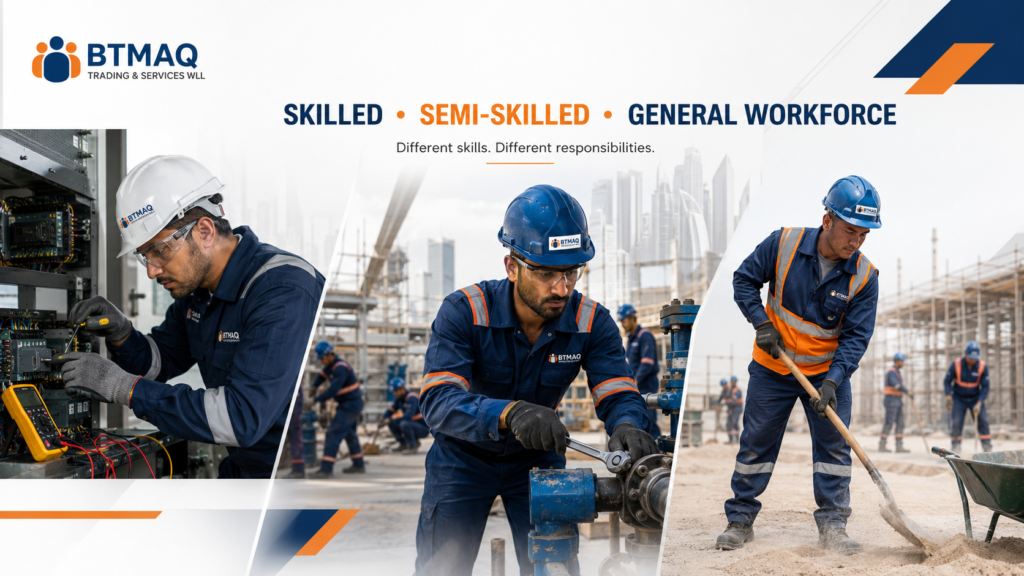
Understanding the difference between workforce categories can help businesses avoid both overstaffing and poor worker-to-task matching.
| Workforce Type | General Character |
| Skilled Manpower | Specialised technical experience, trade knowledge, training or recognised qualifications may be required |
| Semi-Skilled Manpower | Practical experience and task-specific capability |
| Unskilled / General Manpower | General or non-specialist support work |
These are practical workforce categories rather than a universal legal classification. The exact requirements depend on the job, project and working environment.
A business should therefore avoid assuming that every semi-skilled worker can perform every support task.
For example, previous experience assisting one technical team does not automatically make a worker suitable for a different technical assignment.
Where Is Semi-Skilled Manpower Used in Qatar?
Semi-skilled personnel can support a range of operational requirements where practical experience matters but the role does not necessarily require the same level of specialist capability as a highly technical trade.
Construction
Construction projects can require workers who already understand practical site activities and can support defined tasks under the appropriate level of supervision.
The exact workforce mix can change as project work moves from one stage to another.
Maintenance
Maintenance teams may require experienced support personnel who are familiar with practical maintenance-related tasks.
The assigned duties should still be clearly defined so that support workers are not given responsibilities outside their capability.
Industrial Operations
Industrial environments can require practical workers for production and operational support.
Because industrial sites can have specific working procedures, businesses should identify the actual work environment and any relevant site requirements when requesting manpower.
Facility Management
Facility operations can require workers who have practical experience supporting ongoing property-related activities.
The role should be defined according to the actual facility requirement rather than simply using the term “semi-skilled” as a general category.
Material Handling
Material-handling activities may require workers who have relevant practical experience with the tasks involved.
The work requirements should be explained clearly so the supplier can match appropriate workers to the assignment.
MEP Support
Mechanical, electrical and plumbing teams may use support personnel for appropriate non-specialist tasks.
However, support work should not automatically be treated as specialist technical work. Where a task requires a qualified trade professional, the requirement should be specified accordingly.
Site Preparation
Some project preparation activities can require workers with previous practical experience in similar environments.
The exact role should be defined before deployment.
Production Operations
Manufacturing and production environments can require practical support personnel whose previous experience matches the particular operational tasks.
Again, actual assignment fit matters more than the generic label.
What Types of Work Can Semi-Skilled Workers Support?
Instead of building a long list of job titles, it is more useful to look at the type of work involved.
Semi-skilled personnel may support:
- Task-specific construction activities
- Maintenance assistance
- Production support
- Material-handling activities
- Site preparation
- MEP support activities
- Industrial operational work
- Facility-related support
The exact duties should be defined according to the project or business requirement.
This is important because a worker with practical experience in one type of support activity may not automatically be suitable for another. The source material specifically uses the example that experience assisting plumbing teams does not by itself make a worker suitable for electrical support or industrial production.
How Do You Know If You Need Semi-Skilled Manpower?
Before requesting workers, ask a few basic questions.
What Is the Actual Task?
Start by explaining what the worker will actually do.
How Much Practical Experience Is Needed?
Determine whether previous hands-on experience is important for the assignment.
Does the Role Require Specialist Qualification?
Some technical work may require a different workforce category and additional qualifications.
Will the Worker Work Under Supervision?
The level of supervision can help clarify the type of workforce required.
Are There Site-Specific Requirements?
Some projects may require specific induction, PPE, training or other site conditions.
The practical approach is:
Role first → skill requirement second → workforce category third.
That gives the supplier a clearer basis for matching the right worker to the job.
Why Proper Skill Matching Matters
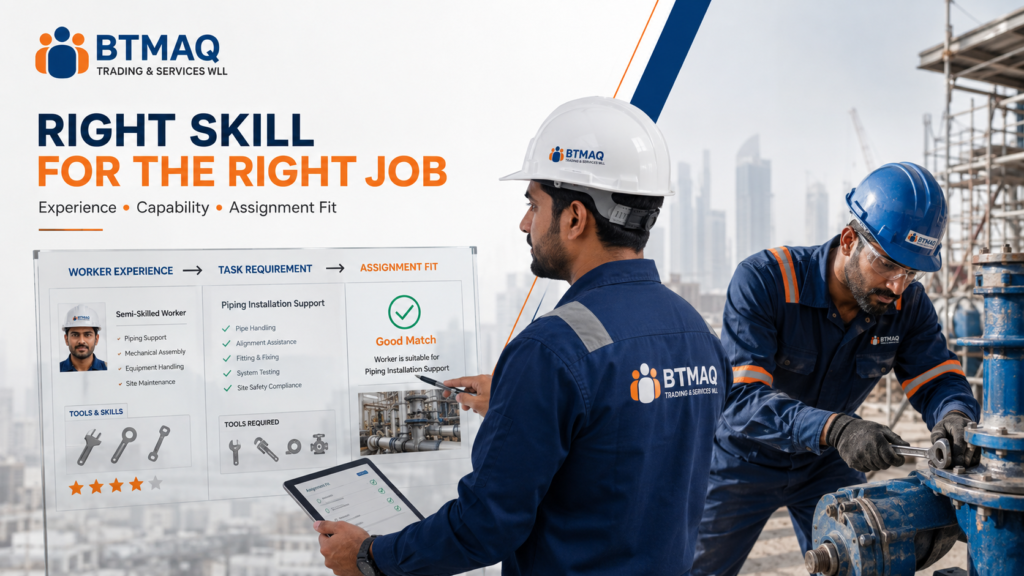
Choosing a workforce category without understanding the actual task can create problems.
A business may technically receive the requested number of workers, but still have a poor workforce match if those workers do not have the experience required for the assignment.
For example, consider two support roles:
Worker A: Practical experience assisting plumbing teams.
Worker B: Practical experience supporting industrial production.
Calling both workers “semi-skilled” does not make them interchangeable.
The correct worker depends on the actual assignment.
Better matching can also help businesses avoid using highly specialised workers for tasks that do not require that level of capability, while reducing the risk of assigning insufficiently experienced workers to tasks that demand more practical experience.
Semi-Skilled Manpower for Different Work Environments
The same workforce category can mean different things depending on where the worker is assigned.
A construction site may need practical support for active site work.
A maintenance team may need experienced assistance with defined maintenance activities.
An industrial operation may need support personnel familiar with production procedures.
A facility management operation may require workers who understand routine property-related tasks.
The environment therefore matters just as much as the skill label.
A good manpower request should describe the actual work environment, duties and expected responsibilities before a worker is proposed.
How to Request Semi-Skilled Manpower in Qatar
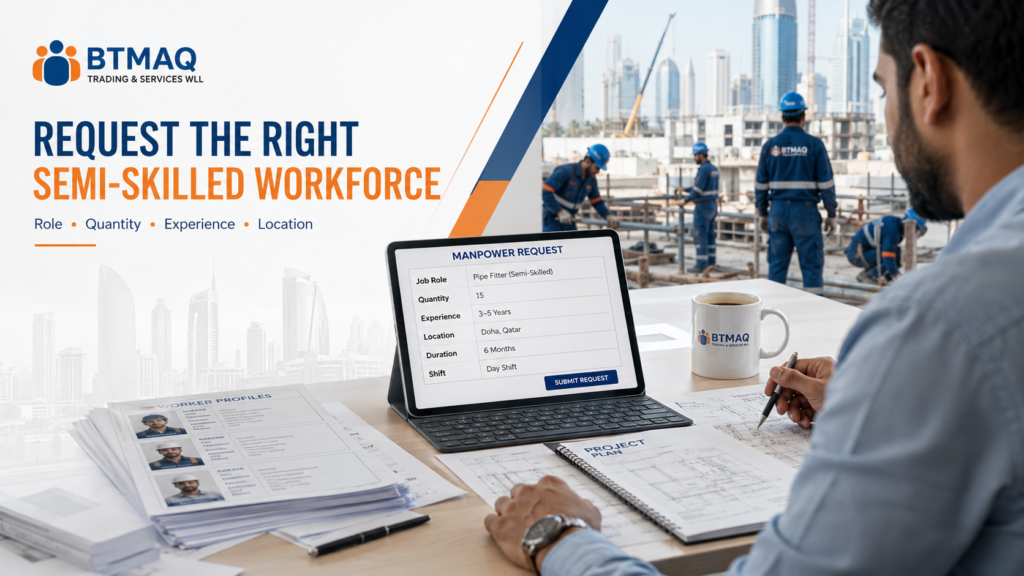
A clear manpower request should give the provider enough information to understand the assignment.
1. Exact Job or Task
Explain what the worker will actually be doing.
2. Number of Workers
State the required quantity for each role where possible.
3. Required Experience
Mention relevant practical experience.
4. Work Location
Provide the actual project or operating location.
5. Start Date
State when the workers are expected to report.
6. Duration
Explain how long the workforce is expected to be required.
7. Working Hours and Shifts
Include normal working hours and shift arrangements.
8. Certifications Where Applicable
Identify any qualification or project-specific requirement that applies to the role.
9. Site Requirements
Mention relevant PPE, induction or other site conditions where applicable.
Providing these details allows the requirement to be assessed according to the actual role and project rather than simply treating “semi-skilled” as a generic worker category.
How Semi-Skilled Manpower Supply Works
The process should begin with understanding the requirement.
Requirement Assessment
First, define the job, quantity, experience and working conditions.
Worker Matching
Suitable personnel can then be compared with the role requirements.
Experience and Capability Review
Relevant experience and practical capability should be considered.
Documentation Review
Where required, relevant qualifications or documentation can be reviewed.
Scheduling and Mobilisation
Once suitable workers are identified and the arrangement is agreed, deployment can be scheduled according to the required date and location.
The purpose of this process is not simply to supply a certain number of workers. It is to create a closer match between the work requirement and workforce capability.
What Should You Check Before Hiring Semi-Skilled Manpower?
Before confirming an arrangement, businesses should consider more than the worker’s job title.
Check:
Relevant experience
Does the worker have experience related to the actual assignment?
Task suitability
Can the worker perform the defined duties at the required level?
Availability
Is the worker genuinely available for the required dates?
Documentation
Are any role-specific documents or qualifications relevant to the assignment?
Site requirements
Does the worker need induction, PPE or other preparation?
Supervision
Will the worker operate under a defined supervisor or team structure?
This helps the business evaluate the workforce based on the job rather than relying on a generic category label.
Semi-Skilled Manpower and Safety
A worker being described as semi-skilled does not mean the worker can automatically perform every technical or site-related task.
Workers should be assigned according to their actual capability and the duties defined for the role.
Where work involves specific site rules, training, PPE or other requirements, those conditions should be identified before deployment.
For current labour-related information and official guidance in Qatar, businesses can also refer to the Qatar Ministry of Labour.
The key principle is simple: specialist tasks should be assigned to people with the appropriate capability and authorisation for the work.
What Affects Semi-Skilled Manpower Supply Cost?
There is no single rate for every semi-skilled workforce requirement.
Cost can vary according to:
- Type of work
- Experience required
- Number of workers
- Duration
- Working hours and shifts
- Work location
- Transportation
- Supervision
- Applicable qualifications or certifications
- Other agreed services
This is why businesses should compare the complete workforce scope rather than looking only at the headline rate.
Two requests with the same worker count can still have very different requirements.
For example, a short assignment requiring one type of practical support is not necessarily comparable with a longer deployment involving multiple shifts, transportation and additional supervision.
Common Mistakes When Hiring Semi-Skilled Manpower
Using “Semi-Skilled” as the Entire Job Description
The label does not explain the actual work.
Not Defining the Required Experience
A worker may have practical experience, but not necessarily the experience your assignment needs.
Mixing Skilled and Semi-Skilled Requirements
Some tasks may require specialist technical capability and should be requested accordingly.
Assuming One Semi-Skilled Worker Can Perform Multiple Technical Roles
Previous experience should be relevant to the assignment.
Focusing Only on Headcount
The right workforce mix matters more than simply obtaining a target number of workers.
Ignoring Site Requirements
PPE, induction, training or other site-specific conditions should be identified early where applicable.
Choosing Only by Price
A lower rate does not automatically mean the workforce is a better match for the assignment.
Why Choose BTMAQ for Semi-Skilled Manpower Supply in Qatar?
BTMAQ currently publishes skilled, semi-skilled and unskilled workforce solutions across Qatar, with semi-skilled manpower positioned alongside its broader workforce services. Its current website also lists workforce coverage across construction, industrial, MEP, logistics, hospitality, cleaning, facility management and infrastructure-related requirements.
For businesses looking for manpower support, BTMAQ’s manpower services in Qatar cover multiple industry-specific workforce requirements. You can also review the broader Manpower Supply in Qatar guide for an overview of workforce categories and supply models.
The actual workforce required should still be assessed according to the role, experience, quantity, location, schedule and project conditions.
Frequently Asked Questions
What is semi-skilled manpower?
Semi-skilled manpower refers to workers with practical experience and task-specific capability who may not require the same level of specialist qualification as highly technical trades.
What is the difference between skilled and semi-skilled manpower?
Skilled roles generally involve a higher level of specialised technical experience, training, trade knowledge or recognised qualifications. Semi-skilled roles focus more on practical experience and task-specific capability.
What is the difference between semi-skilled and unskilled workers?
Semi-skilled workers generally have practical experience for specific tasks, while unskilled or general workers typically perform non-specialist support activities.
Which industries use semi-skilled manpower in Qatar?
Semi-skilled personnel can support construction, maintenance, industrial operations, facility management, material handling, MEP support, site preparation and production operations.
Does semi-skilled manpower require experience?
Practical experience is one of the defining characteristics of the category, but the amount and type of experience required depends on the actual assignment.
Can semi-skilled workers perform specialist technical work?
Not automatically. The worker should only be assigned duties that match their actual capability, experience and any applicable requirements.
What information should I provide when requesting semi-skilled manpower?
Provide the exact task, worker quantity, required experience, location, start date, duration, working hours, shifts and any applicable qualifications or site requirements.
What affects semi-skilled manpower supply cost in Qatar?
Cost can vary according to the type of work, experience, quantity, duration, shifts, location, transportation, supervision and other requirements.
Find the Right Semi-Skilled Workforce for Your Requirement
The goal of semi-skilled manpower supply is not to choose the highest skill level simply because it sounds better.
The goal is to match practical experience and task-specific capability to the actual work.
When businesses clearly define the task, required experience, quantity, location, schedule and site conditions, it becomes easier to assess the right workforce requirement and request suitable manpower.
Request Semi-Skilled Manpower in Qatar
Share your required roles, tasks, workforce quantity, location, start date, duration and working schedule with BTMAQ Trading & Services WLL so the requirement can be reviewed according to the actual assignment.
Phone / WhatsApp: +974 66246371
Email: info@manpoweragencyinqatar.com
Location: Doha, Qatar