








Temporary manpower supply in Qatar helps businesses access workers for a specific project, seasonal workload, emergency requirement or limited contract period without immediately expanding their permanent workforce.
A company may require additional workers for several weeks, a few months or until a project reaches completion. Temporary manpower allows the business to increase or reduce its workforce according to operational demand.
This staffing model is commonly used in construction, logistics, warehousing, hospitality, cleaning, maintenance, events, shutdown projects and infrastructure work.
However, temporary workforce supply is not simply about finding workers quickly. Businesses must also consider worker skills, availability, transportation, accommodation, working hours, safety requirements, replacement support and contract terms.
Choosing an experienced Manpower Supplier in Qatar can help companies manage these requirements through one structured agreement.
Table of Contents
- What Is Temporary Manpower Supply in Qatar?
- How Temporary Manpower Supply Works
- Temporary vs Permanent Manpower
- Seven Benefits of Temporary Manpower Supply
- When Businesses Need Temporary Workers
- Common Temporary Workforce Categories
- Industries That Use Temporary Manpower
- Temporary Manpower Supply Cost
- How to Choose a Temporary Manpower Supplier
- Temporary Manpower Contract Checklist
- Frequently Asked Questions
What Is Temporary Manpower Supply in Qatar?
Temporary manpower supply is a workforce arrangement in which a company receives workers for a defined period or specific operational requirement.
The workers may be required for:
- A short construction phase
- Seasonal business demand
- Warehouse loading and unloading
- Emergency maintenance
- Staff absence coverage
- Hotel or hospitality support
- Event preparation
- Project mobilisation
- Shutdown or turnaround work
- Cleaning and facility support
- Delivery or logistics operations
The manpower supplier normally coordinates worker availability, deployment and agreed workforce support.
The client company manages the workers’ daily site duties according to the agreed job descriptions, working hours and safety procedures.
Temporary supply periods may include:
| Supply period | Common use |
| One day | Events, loading, cleaning or emergency support |
| One week | Short assignments and urgent site work |
| One month | Temporary replacement or seasonal demand |
| Three to six months | Project phases and operational contracts |
| Until project completion | Construction, maintenance or infrastructure work |
| Renewable contract | Ongoing flexible workforce requirements |
The duration should be clearly mentioned in the manpower quotation and supply agreement.
How Temporary Manpower Supply Works
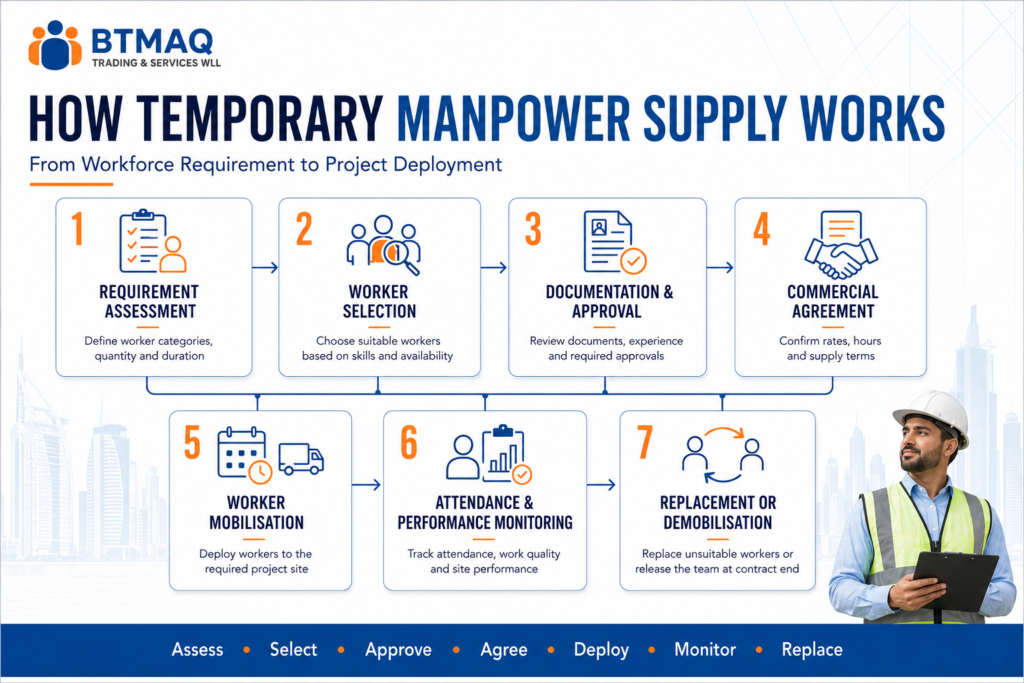
The process begins when a company identifies a temporary workforce shortage or project requirement.
The client provides the manpower supplier with details such as:
- Required worker categories
- Number of workers
- Required experience
- Project location
- Start date
- Contract duration
- Working hours
- Shift schedule
- Weekly working days
- Transportation requirements
- Accommodation responsibility
- PPE requirements
- Required certificates
- Site-access conditions
The manpower supplier then checks worker availability and prepares a quotation.
After commercial and operational terms are approved, workers are screened, assigned and mobilised to the project.
A typical process includes:
Step 1: Requirement assessment
The client identifies the exact roles, quantities and assignment duration.
Step 2: Worker selection
The supplier selects available workers according to the required skills and experience.
Step 3: Documentation and approval
Worker documents, certificates or experience records may be shared for client review when required.
Step 4: Commercial agreement
Both parties confirm the rate, working hours, overtime, transport, accommodation, PPE and payment terms.
Step 5: Worker mobilisation
Workers are transported and deployed according to the agreed start date.
Step 6: Attendance and performance monitoring
Attendance, working hours and site performance are tracked throughout the assignment.
Step 7: Replacement or demobilisation
Workers may be replaced when necessary or demobilised when the temporary contract ends.
Temporary Manpower vs Permanent Manpower
Temporary and permanent manpower serve different business requirements.
| Factor | Temporary manpower | Permanent manpower |
| Employment need | Limited or variable | Long-term and continuous |
| Contract period | Fixed or project-based | Ongoing |
| Workforce flexibility | High | Lower |
| Recruitment commitment | Reduced for the client | Full recruitment process |
| Suitable for seasonal demand | Yes | Often less suitable |
| Suitable for core long-term roles | Sometimes | Usually |
| Workforce reduction | Easier after assignment | More complex |
| Urgent mobilisation | Often faster | Usually slower |
| Project-based staffing | Highly suitable | May create excess staff later |
| Cost structure | Supply rate for agreed service | Salary plus direct employment costs |
Temporary manpower does not automatically replace the need for permanent employees.
A business may maintain permanent supervisors, engineers, managers and core technical staff while using temporary workers for changing operational requirements.
The best workforce structure depends on the project duration, workload stability and required skills.
Seven Benefits of Temporary Manpower Supply in Qatar
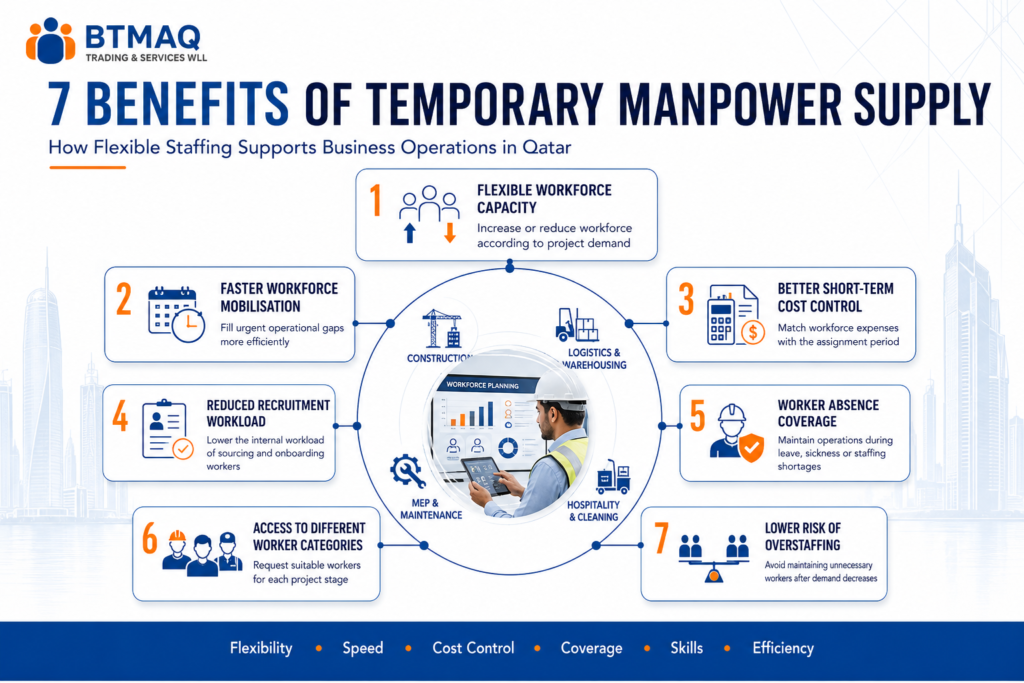
1. Flexible Workforce Capacity
One of the main benefits of temporary manpower supply in Qatar is workforce flexibility.
Business requirements can change quickly.
A contractor may need additional workers during one construction phase but require fewer workers after the phase is completed.
A warehouse may need extra helpers during a high-volume delivery period.
A hotel may need additional service staff during a major conference or peak season.
Temporary supply allows companies to increase their workforce when demand rises and reduce it when the assignment ends.
This helps prevent two common problems:
- Having too few workers during busy periods
- Maintaining unnecessary workers after demand decreases
Flexible manpower planning can improve project control and labour utilisation.
2. Faster Workforce Mobilisation
Permanent recruitment may require advertising, interviewing, testing, document processing and onboarding.
Temporary manpower suppliers may already have workers available or maintain access to a wider workforce pool.
This can reduce the time required to fill urgent operational gaps.
Fast mobilisation is particularly useful when:
- A project start date changes suddenly
- Workers are absent
- A new contract begins
- The workload increases unexpectedly
- The client requests additional workers
- A deadline must be recovered
- Emergency maintenance is required
The actual mobilisation time depends on worker availability, role complexity, project location and site approvals.
Businesses should avoid assuming that every worker category can be supplied immediately. Specialised technicians may require additional screening or client approval.
3. Better Control of Short-Term Labour Costs
Hiring permanent workers for a temporary requirement may create unnecessary long-term costs.
Temporary supply provides a defined cost for a specific assignment or period.
Depending on the agreement, the rate may include:
- Worker remuneration
- Accommodation
- Food or allowances
- Transportation
- PPE
- Payroll coordination
- Attendance management
- Mobilisation
- Replacement support
- Supplier administration
This can make project budgeting easier when the quotation is transparent.
Companies should still compare complete service packages rather than selecting the lowest headline rate.
Read the complete guide to manpower supply cost in Qatar before comparing temporary workforce quotations.
4. Reduced Recruitment Workload
Recruiting multiple workers requires time and internal resources.
The process may involve:
- Reviewing applications
- Conducting interviews
- Checking experience
- Testing technical skills
- Collecting documents
- Preparing agreements
- Organising accommodation
- Arranging transport
- Issuing PPE
- Managing payroll
- Finding replacements
A temporary manpower supplier can coordinate many of these operational tasks according to the service agreement.
This allows the client’s management team to focus on project execution, quality, customer service and business operations.
The client must still provide accurate job descriptions, site instructions and supervision.
5. Coverage for Worker Absence
Unexpected absence can affect productivity.
Businesses may face workforce gaps because of:
- Sickness
- Annual leave
- Emergency leave
- Resignation
- Contract completion
- Worker transfer
- Performance issues
- Project reassignment
Temporary workers can help maintain operations while the company resolves the permanent staffing requirement.
This is useful for roles where even a small staffing shortage can disrupt daily work, such as:
- Cleaners
- Warehouse helpers
- Drivers
- Hotel support staff
- Maintenance technicians
- Loading workers
- Kitchen helpers
- Site labourers
Replacement expectations should be agreed with the manpower supplier before the contract begins.
6. Access to Different Worker Categories
A business may need several types of workers during different project stages.
For example, a construction project may require:
- General workers for site preparation
- Steel fixers and carpenters for structural work
- Electricians and plumbers for MEP installation
- HVAC technicians for mechanical systems
- Painters and finishing workers
- Cleaners before project handover
Recruiting every category permanently may not be practical.
Temporary workforce supply allows businesses to request specific worker categories when each project phase begins.
Companies can review specialist workforce solutions for:
- Construction manpower supply in Qatar
- MEP manpower supply in Qatar
- HVAC manpower supply in Qatar
- Road and infrastructure manpower
7. Lower Risk of Workforce Overstaffing
Project demand does not always remain constant.
A company may need 100 workers during peak activity but only 40 workers after major work is completed.
If all workers are recruited for permanent positions, the company may face an excess workforce after the project slows down.
Temporary supply allows workforce numbers to match actual project demand.
A phased workforce plan may look like this:
| Project stage | Temporary workforce requirement |
| Mobilisation | 20 workers |
| Main project activity | 80 workers |
| Peak period | 120 workers |
| Finishing stage | 50 workers |
| Handover | 15 workers |
This approach can improve workforce utilisation and reduce unnecessary labour expenses.
However, the manpower contract should clearly explain how worker quantities can be increased or reduced.
When Do Businesses Need Temporary Workers?
Temporary manpower is suitable when the requirement has a clear operational reason and limited duration.
New project mobilisation
A newly awarded project may require workers before permanent recruitment can be completed.
Seasonal workload
Hotels, warehouses, logistics companies and retail-support operations may experience temporary increases in demand.
Project deadline recovery
Additional workers may be required when a project falls behind schedule.
Emergency replacement
Workers may be needed quickly to cover absence, resignation or unexpected shortages.
Short-term contracts
A company may receive a service contract lasting only a few weeks or months.
Shutdown and turnaround work
Industrial shutdowns often require large numbers of skilled workers for a short, intensive period.
Read more about shutdown manpower supply in Qatar.
Events and exhibitions
Temporary workers may assist with setup, cleaning, hospitality, crowd support, loading and dismantling.
Warehouse peaks
Warehouses may require additional manpower during stock arrivals, order increases or inventory periods.
Explore warehouse manpower supply in Qatar.
Hotel and hospitality demand
Hotels and catering operations may need temporary service workers during conferences, festivals, weddings or peak occupancy.
See the guide to hospitality manpower supply in Qatar.
Common Temporary Manpower Categories
Temporary manpower may include skilled, semi-skilled and general workers.
General workers
- General labourers
- Helpers
- Loading and unloading workers
- Packing workers
- Warehouse assistants
- Site cleaners
- Office boys
- Kitchen helpers
Construction workers
- Masons
- Carpenters
- Steel fixers
- Scaffolders
- Painters
- Tile workers
- Gypsum workers
- Civil helpers
MEP and maintenance workers
- Electricians
- Plumbers
- Pipe fitters
- Duct workers
- HVAC technicians
- Mechanical helpers
- Maintenance technicians
- Fire-fighting technicians
Logistics and warehouse workers
- Warehouse helpers
- Pickers and packers
- Loaders
- Forklift operators
- Drivers
- Delivery assistants
- Inventory assistants
Hospitality workers
- Waiters
- Kitchen helpers
- Housekeeping staff
- Cleaners
- Stewards
- Food-service assistants
- Banquet helpers
Industrial workers
- Welders
- Fabricators
- Riggers
- Mechanical fitters
- Equipment operators
- Safety assistants
- Shutdown helpers
The supplier should not provide workers based only on a job title.
The client should specify the actual duties, tools, equipment and experience required.
Industries That Use Temporary Manpower in Qatar
Construction
Construction companies use temporary workers to manage changing labour needs during different project phases.
Key considerations include:
- Trade experience
- PPE
- Transportation
- Site access
- Working hours
- Accommodation
- Safety induction
Oil and gas
Oil and gas assignments may require technical qualifications, safety training and client approval.
Relevant roles may include welders, pipe fitters, riggers, mechanical technicians and shutdown workers.
Read about oil and gas manpower supply in Qatar.
Logistics
Logistics companies may require temporary drivers, helpers, loaders and warehouse workers during high-demand periods.
Read the logistics manpower supply guide.
Warehousing
Warehouse operations may use temporary manpower for stock arrivals, order fulfilment, packing, inventory counts and dispatch support.
Hospitality
Hotels, restaurants, catering companies and event venues may need short-term service and support workers.
Cleaning and facility services
Temporary cleaners may be required for project handover, events, deep cleaning, staff replacement or new facility mobilisation.
See cleaning manpower supply in Qatar.
Road and infrastructure
Infrastructure projects may require temporary general workers, equipment helpers, technicians and skilled trades during peak construction phases.
Temporary Manpower Supply Cost in Qatar
There is no fixed price for every temporary worker.
The cost depends on:
- Worker category
- Skill level
- Number of workers
- Contract duration
- Working hours
- Overtime
- Shift timing
- Project location
- Accommodation
- Food
- Transportation
- PPE
- Required certification
- Mobilisation speed
- Replacement conditions
Short-term supply can sometimes have a higher rate per worker because mobilisation, transport, administration and PPE costs are spread across a shorter contract period.
A larger or longer requirement may allow the supplier to plan resources more efficiently.
The quotation should clearly show whether the rate is:
- Hourly
- Daily
- Weekly
- Monthly
- Project-based
- Based on normal hours plus overtime
Businesses should request an itemised quotation rather than accepting a single unexplained rate.
Information Required for an Accurate Quotation
Provide the following information when requesting temporary workers:
| Requirement | Details to provide |
| Worker category | Helper, electrician, cleaner, driver or technician |
| Quantity | Exact number of workers |
| Start date | Expected mobilisation date |
| Duration | Days, weeks, months or project completion |
| Location | Exact project or worksite |
| Working hours | Daily normal hours |
| Working days | Days per week |
| Shift | Day, night or rotating |
| Overtime | Expected additional hours |
| Accommodation | Client or supplier responsibility |
| Transportation | Client or supplier responsibility |
| Food | Client or supplier responsibility |
| PPE | Required equipment and responsible party |
| Certification | Trade licence, safety training or client approval |
| Supervision | Whether a dedicated supervisor is required |
Incomplete information can lead to an inaccurate quotation and later cost adjustments.
How to Choose a Temporary Manpower Supplier in Qatar
Verify relevant workforce experience
The supplier should understand the workforce requirements of your industry.
A supplier experienced in hospitality may not automatically be suitable for a technical shutdown project.
Confirm worker availability
Ask whether the required workers are currently available and how long mobilisation will take.
Review worker qualifications
For skilled roles, review experience records, certificates or trade-test results when applicable.
Request a detailed quotation
The quotation should explain:
- Included working hours
- Overtime rate
- Accommodation
- Food
- Transport
- PPE
- Mobilisation
- Replacement
- Supervision
- Payment terms
Check replacement support
Ask what happens if a worker is unsuitable, absent or unable to continue.
Review workforce management
Confirm how attendance, timesheets, overtime and site communication will be managed.
Check contract flexibility
The agreement should explain whether worker numbers can be increased, reduced or extended.
For a broader evaluation checklist, read How to Choose the Right Manpower Supplier in Qatar.
Temporary Manpower Supply Contract Checklist
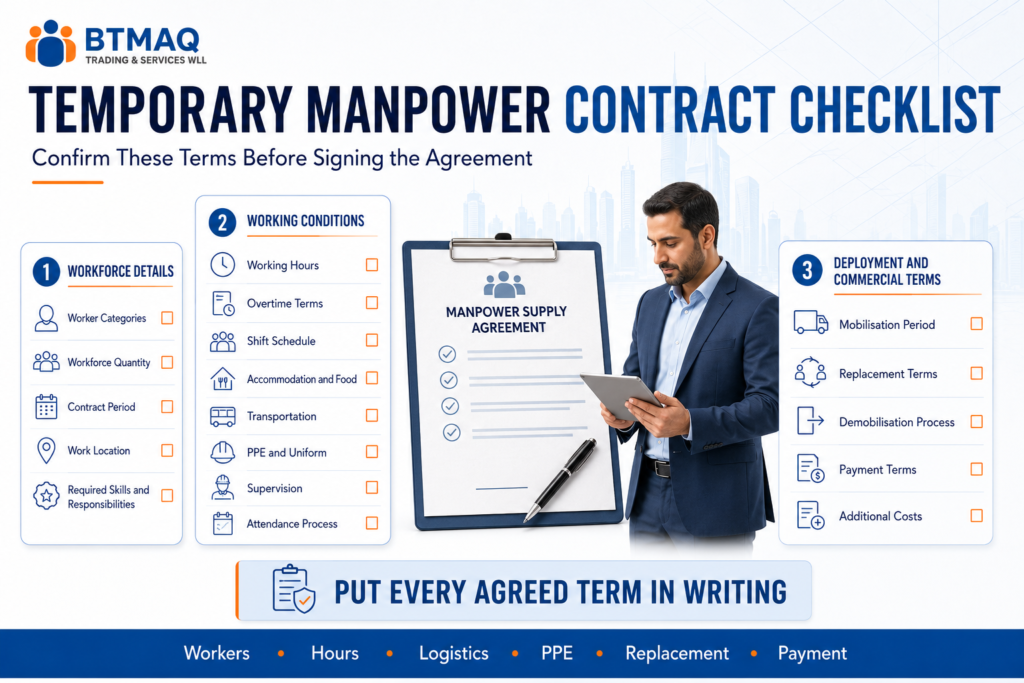
Before signing a temporary manpower agreement, confirm the following terms:
| Contract item | What to confirm |
| Worker categories | Exact job titles and responsibilities |
| Quantity | Number of workers supplied |
| Contract period | Start and end dates |
| Working hours | Normal daily and weekly hours |
| Overtime | Rate and approval process |
| Work location | Main site and any additional sites |
| Accommodation | Responsible party |
| Food | Responsible party |
| Transportation | Responsible party |
| PPE | Included and excluded items |
| Supervision | Client or supplier responsibility |
| Attendance | Timesheet and approval process |
| Replacement | Conditions and response time |
| Mobilisation | Expected deployment period |
| Demobilisation | Notice and process |
| Payment terms | Invoice cycle and due date |
| Additional costs | Any charges outside the main rate |
Verbal promises should be included in the written quotation or agreement.
Common Mistakes to Avoid
Choosing only by price
A low rate may exclude transportation, PPE, accommodation, overtime or replacement support.
Providing an unclear job description
A general job title may result in workers who do not match the actual duties.
Requesting workers too late
Very short notice can limit worker availability and increase mobilisation pressure.
Ignoring working-hour details
The contract must clearly define normal hours, overtime and shifts.
Failing to confirm site requirements
Workers may require induction, PPE, identification, certificates or access approval before starting.
Not planning demobilisation
The supplier should know when workers will be released, reduced or extended.
Using unqualified workers for technical tasks
Assigning unsuitable workers can cause safety issues, rework and delays.
How to Manage Temporary Workers Effectively
Temporary workers require proper management after deployment.
Businesses should:
- Provide clear job instructions
- Conduct site induction
- Assign a responsible supervisor
- Record attendance daily
- Approve overtime in writing
- Provide required tools and equipment
- Monitor performance
- Report problems quickly
- Maintain safe working conditions
- Coordinate workforce changes with the supplier
Temporary workers should understand who they report to and what tasks they are authorised to perform.
Good communication between the client, supplier and workers helps prevent confusion and delays.
Frequently Asked Questions
What is temporary manpower supply in Qatar?
It is a staffing arrangement where workers are supplied for a limited period, specific project, seasonal requirement or temporary workforce shortage.
How long can temporary workers be supplied?
Workers may be supplied for one day, several weeks, a few months or until a project is completed. The duration should be stated in the agreement.
Can temporary workers be supplied urgently?
Urgent mobilisation may be possible when suitable workers are available. Deployment time depends on quantity, skill level, location and site requirements.
Is temporary manpower cheaper than permanent recruitment?
It may be more cost-effective for short-term or variable requirements because the client does not maintain unnecessary permanent staff after the assignment ends.
Are accommodation and transportation included?
This depends on the quotation. The agreement should clearly state whether accommodation, food, transport and PPE are included.
Can temporary workers be replaced?
Replacement may be available when a worker is unsuitable, absent or unable to continue. The replacement terms should be agreed in writing.
What industries use temporary manpower?
Construction, oil and gas, hospitality, cleaning, logistics, warehousing, maintenance, infrastructure and events commonly use temporary workers.
How is temporary manpower priced?
Pricing may be hourly, daily, weekly, monthly or project-based. It depends on skill, quantity, hours, duration and included services.
Can I increase the number of workers during the contract?
Additional workers may be supplied based on availability and agreed rates. The contract should explain the process for increasing or reducing workforce numbers.
Conclusion
Temporary manpower supply in Qatar gives businesses a practical way to manage project demand, seasonal workloads, urgent shortages and short-term contracts.
It provides workforce flexibility without requiring every temporary role to become a permanent position.
However, successful temporary manpower supply depends on proper planning.
Businesses should define the required worker categories, contract duration, working hours, location, transportation, accommodation, PPE and replacement expectations before requesting a quotation.
A transparent agreement and experienced manpower supplier can help reduce staffing delays, control costs and maintain project productivity.
Get Your Free Quote
📞 BTMAQ Responds Within 4 Hours
📱 WhatsApp / Phone: +974 66246371
📧 Email: info@manpoweragencyinqatar.com
📍 Office: Doha, Qatar