








Manpower supply cost in Qatar depends on much more than a worker’s monthly salary. The worker’s skill level, working hours, accommodation, food, transport, personal protective equipment, contract duration and project location can all affect the final supply rate.
This is why two manpower suppliers may provide very different quotations for the same number of workers.
A lower quotation may exclude overtime, transportation, accommodation or replacement support. A higher quotation may include most workforce-related expenses in one monthly rate.
Before selecting a Manpower Supplier in Qatar, businesses should understand exactly what is included in the quotation.
Table of Contents
- What Determines Manpower Supply Cost in Qatar?
- Is There a Fixed Manpower Supply Rate?
- Qatar’s Minimum Wage and Labour Costs
- Seven Main Factors That Affect Pricing
- Manpower Costs for Different Industries
- How to Compare Manpower Supply Quotations
- Common Hidden Costs
- How to Control Your Manpower Budget
- Frequently Asked Questions
What Determines Manpower Supply Cost in Qatar?
The final manpower supply rate usually combines several workforce expenses.
| Cost component | What it may include |
| Worker remuneration | Basic salary and applicable allowances |
| Accommodation | Labour accommodation or housing allowance |
| Food | Meals or food allowance |
| Transportation | Daily transport between accommodation and worksite |
| Overtime | Additional working hours, night work or rest-day work |
| PPE and uniform | Helmet, safety shoes, vest, gloves and uniform |
| Administration | Payroll, attendance, documentation and coordination |
| Recruitment and mobilisation | Worker sourcing, processing and deployment |
| Insurance and medical support | Applicable insurance, medical and welfare expenses |
| Supplier service charge | Management, supervision and operational margin |
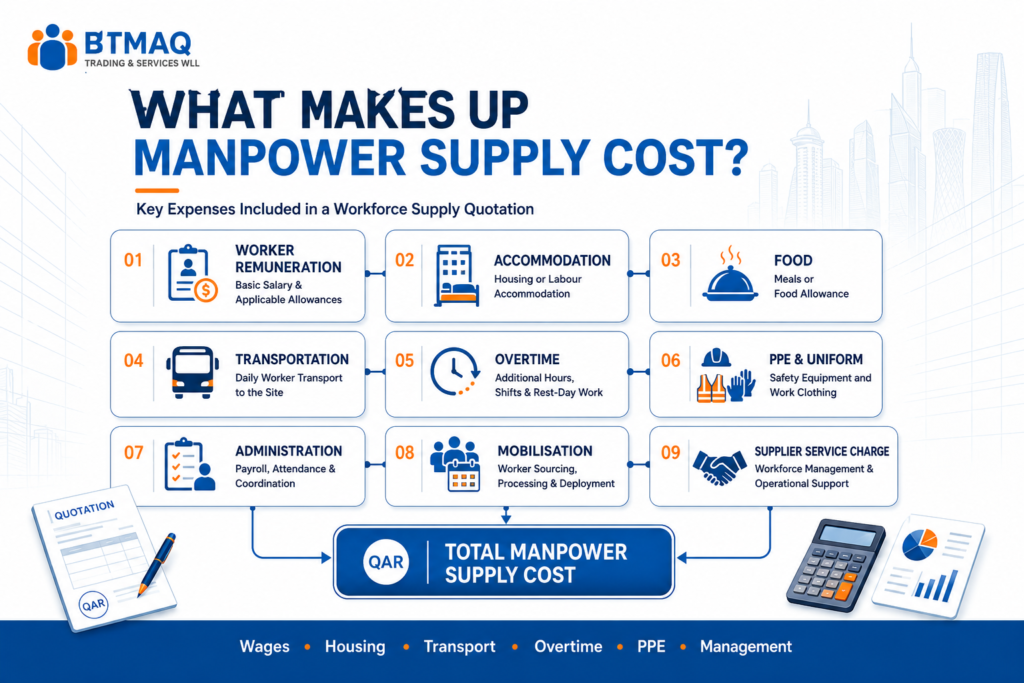
Therefore, the manpower supply cost in Qatar should not be judged only by the worker’s basic wage.
Businesses should ask for a detailed cost breakdown before approving any quotation.
Is There a Fixed Manpower Supply Rate in Qatar?
There is no single fixed commercial rate that applies to every worker, project or manpower supplier.
The price of a general helper will normally be different from the price of a certified electrician, HVAC technician, welder, plumber, machine operator or site supervisor.
Rates may also change depending on:
- Number of workers required
- Worker qualifications
- Project duration
- Daily working hours
- Shift pattern
- Worksite location
- Accommodation requirements
- Transportation distance
- PPE requirements
- Urgency of deployment
- Replacement conditions
- Site-specific safety requirements
For example, a long-term requirement for 50 general workers may be priced differently from an urgent request for five specialised technicians.
Businesses should therefore request a customised quotation rather than relying on a general online rate.
Qatar’s Minimum Wage and Labour Costs
Qatar introduced a minimum basic wage of QAR 1,000 per month. Employers must also provide at least QAR 500 for accommodation and QAR 300 for food when adequate accommodation and food are not supplied directly. These amounts represent minimum employment requirements, not the final commercial manpower supply rate.
The complete supply rate can be higher because it may include transportation, overtime, PPE, payroll processing, worker management, insurance, mobilisation and supplier operating costs.
Qatar’s Wage Protection System also enables authorities to monitor wage payments and helps ensure that workers receive their contractual wages through the regulated banking system.
A quotation that appears unusually low should therefore be reviewed carefully to confirm that wages, allowances and workforce obligations have been properly considered.
Seven Factors That Affect Manpower Supply Cost in Qatar
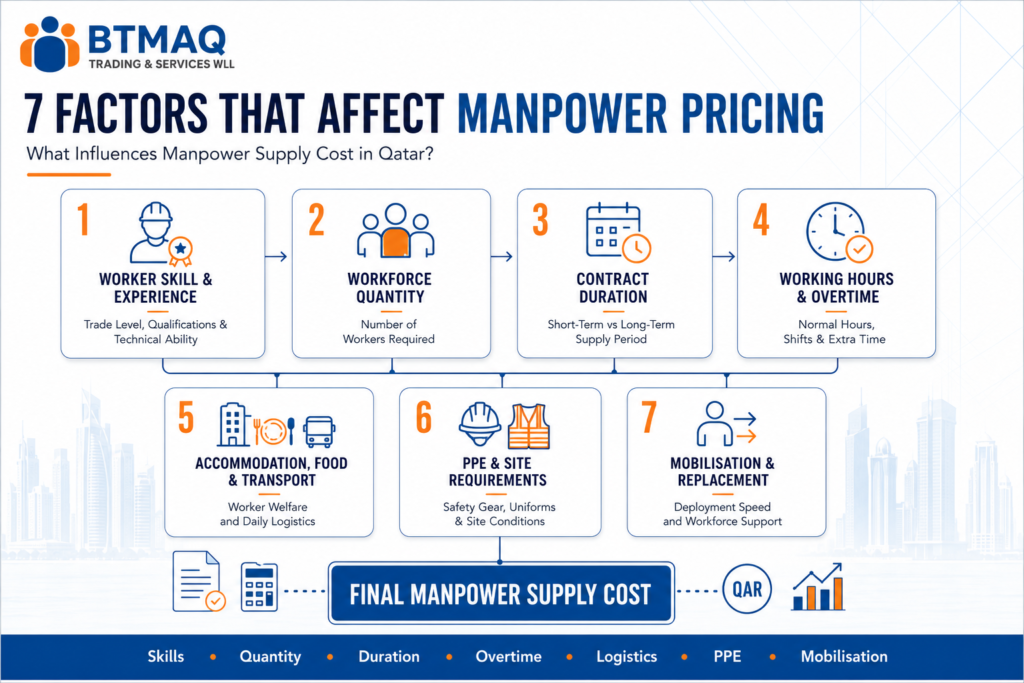
1. Worker Skill and Experience
Skill level is one of the biggest pricing factors.
General workers and helpers usually require less specialised training than electricians, welders, plumbers, HVAC technicians or equipment operators.
Specialised workers may need:
- Trade certificates
- Previous Qatar or GCC experience
- Equipment licences
- Safety training
- Technical testing
- Client approval
- Industry-specific certification
The more specialised the role, the greater the recruitment, assessment and replacement cost may be.
Businesses requiring technical workers can review BTMAQ’s guides for MEP manpower supply in Qatar and HVAC manpower supply in Qatar.
2. Number of Workers Required
The total number of workers can affect the rate per worker.
A larger workforce requirement may allow accommodation, transportation and supervision costs to be distributed across more workers.
However, large deployments may also require:
- Additional buses
- More accommodation capacity
- Dedicated supervisors
- Attendance coordinators
- Larger PPE inventories
- Faster recruitment and mobilisation
The supplier should be given the exact workforce quantity and expected mobilisation schedule.
Instead of requesting “around 30 workers,” businesses should specify whether they need:
- 20 general helpers
- 5 carpenters
- 3 electricians
- 2 supervisors
This produces a more accurate quotation.
3. Contract Duration
Contract duration directly affects the manpower supply cost in Qatar.
Common supply periods include:
- Daily or event-based supply
- Weekly supply
- One-month temporary supply
- Three-to-six-month project supply
- One-year workforce contract
- Renewable long-term agreement
Short-term projects may have higher mobilisation and administration costs per worker.
Longer contracts may provide better workforce stability and allow suppliers to plan accommodation, transportation and worker allocation more efficiently.
However, companies should not choose a longer contract only to receive a lower rate. The duration should match the actual project schedule.
4. Working Hours, Overtime and Shifts
The quotation must clearly state the number of normal working hours included.
Under Qatar Labour Law, ordinary working hours generally cannot exceed eight hours per day or 48 hours per week. During Ramadan, the maximum is generally six hours per day or 36 hours per week.
Additional working hours are normally treated as overtime. Qatar Labour Law provides for an overtime increase of at least 25% over the basic hourly wage. Except for shift workers, work between 9:00 p.m. and 6:00 a.m. carries an increase of at least 50% over the basic wage.
The buyer should clarify:
- Normal daily hours
- Number of working days
- Overtime expectations
- Day or night shift
- Friday or rest-day work
- Ramadan schedule
- Public holiday requirements
Without this information, the initial quotation may not reflect the final monthly invoice.
5. Accommodation, Food and Transportation
Some quotations include accommodation, food and transportation. Others include only the worker’s service.
The quotation should answer the following questions:
- Who provides accommodation?
- Is food supplied directly or paid as an allowance?
- Who transports workers to the site?
- Is transportation available for multiple shifts?
- Is the worksite outside central Doha?
- Is transport needed between multiple sites?
- Are workers required to report at different times?
A distant project location can increase transport time, fuel use, bus requirements and operational coordination.
Construction and infrastructure projects should review these requirements carefully when arranging construction manpower supply in Qatar or road and infrastructure manpower.
6. PPE, Uniforms and Site Requirements
PPE requirements vary between industries and worksites.
Basic PPE may include:
- Safety helmet
- Safety shoes
- Reflective vest
- Gloves
- Safety glasses
- Work uniform
Some sites may require additional equipment, including:
- Fire-resistant clothing
- Full-body harnesses
- Respiratory protection
- Welding shields
- Chemical-resistant gloves
- Special identification cards
- Client-branded uniforms
Outdoor work may also require additional heat-stress precautions.
Qatar’s heat-stress rules prohibit outdoor work at exposed sites between 10:00 a.m. and 3:30 p.m. from 1 June to 15 September. Work must also stop when the workplace WBGT level exceeds 32.1°C.
Training, health checks, drinking water, rest arrangements and suitable protective equipment may therefore affect project planning and workforce costs.
7. Mobilisation, Replacement and Workforce Management
A manpower quotation may include more than worker deployment.
The supplier may also handle:
- Worker screening
- Trade testing
- Documentation
- Mobilisation
- Attendance records
- Payroll coordination
- Worker replacements
- Site communication
- Performance follow-up
- Supervisor support
Urgent mobilisation may cost more because workers, transport, PPE and documentation must be arranged within a short period.
Replacement terms should also be clear.
Ask whether the supplier will replace a worker who:
- Does not meet the required skill level
- Is absent repeatedly
- Fails the client’s assessment
- Leaves the assignment
- Cannot continue for medical or operational reasons
A lower rate without replacement support may eventually cost more than a structured manpower agreement.
Manpower Costs for Different Industries
Different industries have different workforce and compliance requirements.
| Industry | Main pricing considerations |
| Construction | Trade skills, PPE, transport, project duration and site access |
| Oil and gas | Certification, technical experience, safety approval and specialised PPE |
| Shutdown projects | Urgent mobilisation, overtime, shifts and short project duration |
| MEP | Technical testing, tools, certification and worker experience |
| HVAC | Technician grade, equipment experience and maintenance skills |
| Warehouse | Shift pattern, lifting duties, equipment operation and transport |
| Logistics | Drivers, helpers, shift timing and multiple work locations |
| Hospitality | Grooming, communication, uniforms and flexible shifts |
| Cleaning | Cleaning materials, machinery, supervision and site size |
Businesses working in specialised sectors can review the following resources:
- Oil and gas manpower supply in Qatar
- Shutdown manpower supply in Qatar
- Warehouse manpower supply in Qatar
- Logistics manpower supply in Qatar
- Hospitality manpower supply in Qatar
- Cleaning manpower supply in Qatar
How to Compare Manpower Supply Quotations
Do not compare quotations using only the final monthly amount.
Use this checklist when reviewing quotations from two manpower suppliers. Record the relevant details separately before making a final decision.
| Quotation item | Supplier A — Quotation Details | Supplier B — Quotation Details |
|---|---|---|
| Worker category and skill level | — | — |
| Normal working hours | — | — |
| Working days per week | — | — |
| Overtime rate | — | — |
| Accommodation included | ☐ Yes ☐ No | ☐ Yes ☐ No |
| Food included | ☐ Yes ☐ No | ☐ Yes ☐ No |
| Transportation included | ☐ Yes ☐ No | ☐ Yes ☐ No |
| PPE included | ☐ Yes ☐ No | ☐ Yes ☐ No |
| Medical or insurance responsibility | — | — |
| Mobilisation time | — | — |
| Replacement policy | — | — |
| Supervisor included | ☐ Yes ☐ No | ☐ Yes ☐ No |
| Contract duration | — | — |
| Payment terms | — | — |
| Additional charges | — | — |
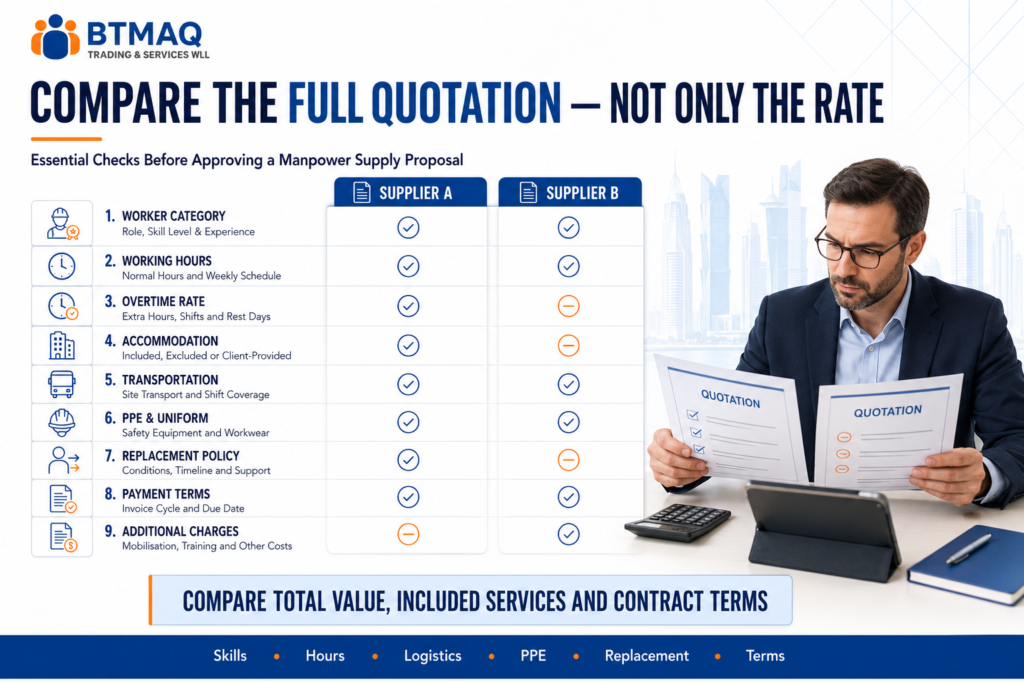
The cheapest quotation is not always the lowest-cost solution.
A quotation that excludes transportation, PPE and worker replacement may create additional expenses after the contract begins.
For further supplier evaluation criteria, read How to Choose the Right Manpower Supplier in Qatar.
Common Hidden Manpower Supply Costs
Businesses should check for costs that may not appear clearly in the main quotation.
Common examples include:
- Overtime charges
- Night-shift premiums
- Friday or rest-day work
- Public holiday work
- Additional transportation
- Remote-site transport
- Extra PPE
- Client-required training
- Worker trade tests
- Site passes
- Short-notice mobilisation
- Replacement transportation
- Contract extension fees
- Demobilisation costs
- Dedicated supervision
The quotation should clearly identify which costs are included, excluded or charged separately.
How to Calculate a Manpower Supply Budget
A simplified budgeting formula is:
Estimated manpower budget = worker cost + allowances + overtime + accommodation + food + transportation + PPE + administration + mobilisation + supplier service charge
For a more accurate estimate, provide the supplier with:
- Worker categories
- Number of workers
- Project location
- Start date
- Contract duration
- Daily working hours
- Weekly working days
- Shift schedule
- Accommodation responsibility
- Food responsibility
- Transportation responsibility
- PPE requirements
- Required certificates
- Replacement expectations
The more detailed the requirement, the more accurate the quotation will be.
How to Reduce Manpower Supply Cost in Qatar
Companies can control manpower expenses without compromising workforce quality.
Plan requirements early
Urgent hiring can increase mobilisation and coordination expenses. Submit workforce requirements before the project start date whenever possible.
Use the correct skill level
Do not hire highly specialised workers for duties that can be completed by semi-skilled workers or general helpers.
At the same time, assigning unqualified workers to technical tasks may cause delays, rework and safety risks.
Provide an accurate project schedule
A clear mobilisation and demobilisation plan prevents unnecessary worker idle time.
Compare complete quotation packages
Compare accommodation, transport, PPE, overtime and replacement support—not only the headline rate.
Track attendance and overtime
Daily attendance records help prevent invoice disputes and uncontrolled overtime.
Choose a suitable contract duration
Match the manpower agreement with the actual project period. Avoid repeated short extensions when the project duration is already known.
Questions to Ask Before Accepting a Quotation
Before approving the manpower supply cost in Qatar, ask the supplier:
- What is included in the quoted rate?
- What is excluded?
- How many working hours are included?
- How is overtime calculated?
- Who provides accommodation?
- Who provides food?
- Who provides transportation?
- Is PPE included?
- How quickly can workers be mobilised?
- Are workers already available in Qatar?
- What happens if a worker is unsuitable?
- Is replacement support included?
- Are there additional site or mobilisation charges?
- What documents will be provided?
- What are the invoice and payment terms?
The answers should be included in the written quotation or manpower supply agreement.
Frequently Asked Questions
What is the average manpower supply cost in Qatar?
There is no single average rate for every worker. Prices vary according to skill, quantity, working hours, accommodation, transportation, PPE, contract duration and project requirements.
Does the manpower rate include accommodation?
It depends on the quotation. Some suppliers provide an all-inclusive rate, while others exclude accommodation, food or transportation. Confirm every cost in writing.
Is overtime included in the monthly manpower rate?
Normal working hours may be included, but overtime is commonly calculated separately. The quotation should clearly state the included hours and overtime formula.
Why do skilled workers cost more?
Skilled workers may require qualifications, experience, trade testing, technical certification and specialised safety training. These requirements increase sourcing and management costs.
Is a cheaper manpower quotation always better?
No. A lower quotation may exclude transport, PPE, accommodation, supervision or replacement support. Compare the full service scope before choosing a supplier.
How can I receive an accurate manpower quotation?
Provide worker categories, quantities, project location, duration, shifts, working hours, accommodation, transportation and PPE requirements.
Can manpower supply cost change during the contract?
It can change when the workforce quantity, working hours, project location, shift pattern or service scope changes. Contract terms should explain how variations will be handled.
Conclusion
Understanding the manpower supply cost in Qatar helps businesses avoid hidden expenses, inaccurate budgeting and workforce disputes.
The final rate should reflect the worker’s skill level, legal wage obligations, working hours, accommodation, transport, PPE, mobilisation, replacement support and workforce management.
Before selecting a supplier, request a detailed written quotation and compare every included service.
A transparent quotation may not always have the lowest headline price, but it can provide better cost control throughout the project.
Get Your Free Quote
📞 BTMAQ Responds Within 4 Hours
📱 WhatsApp / Phone: +974 66246371
📧 Email: info@manpoweragencyinqatar.com
📍 Office: Doha, Qatar