





For technical roles, a worker’s job title or CV does not always show how well they can perform the actual work. In some cases, practical ability needs to be demonstrated and assessed before a worker is assigned.
A Trade-Tested Manpower Supplier can support businesses by using trade or technical assessments for relevant roles while also considering experience, qualifications, documentation, availability, and assignment fit.
Businesses that need a broader understanding of manpower providers can also review our Manpower Supplier in Qatar Guide 2026.

What Is a Trade-Tested Manpower Supplier?
A trade-tested manpower supplier is a workforce provider that may use practical or technical assessments for relevant technical roles.
The purpose of trade testing is to assess whether a worker can demonstrate practical ability related to the role rather than relying only on a CV or job title.
Trade testing is not the same as complete worker screening. Experience, qualifications, documentation, availability, and assignment suitability may also need to be reviewed.
Why Does Trade Testing Matter for Technical Manpower?
Technical jobs often involve practical tasks. A worker may have previous experience on paper, but the business may still need to understand whether that experience matches the actual requirement.
Trade testing can help assess areas such as:
- Practical skill
- Task performance
- Role suitability
- Demonstrated technical ability
It should not be treated as a guarantee of overall worker quality. Rather, it is one part of the wider workforce evaluation process.
Which Types of Roles May Require Trade Testing?
Trade testing is mainly relevant where practical technical ability needs to be demonstrated.
Depending on the requirement, this may include:
- Welding-related roles
- Mechanical roles
- Electrical roles
These are examples rather than an exhaustive list, and trade testing is not automatically mandatory for every role.
Businesses should define the actual job and required capability before deciding whether a practical assessment is relevant.
What Does a Trade Assessment Look At?
There is no single assessment format that applies to every technical position.
The assessment may focus on whether the worker can demonstrate practical ability related to the role, perform relevant tasks, and show the technical capability expected for the assignment.
The exact assessment should therefore depend on the job rather than using one generic test for every worker.
Trade Testing vs Experience Verification
These are two different parts of worker evaluation.
Trade Testing
Can the worker demonstrate relevant practical ability?
Experience Verification
Has the worker actually performed related work before?
Previous employment history can help establish whether a worker has relevant experience, but years of experience alone do not demonstrate every practical skill required for a particular assignment.
For businesses comparing different workforce categories, our Blue Collar Manpower Supplier article provides additional context on blue-collar workforce.
Trade Testing vs Qualification and Certification Review
A practical assessment and a qualification check answer different questions.
Trade Testing
→ Can the worker demonstrate the required practical ability?
Qualification or Certification Review
→ Does the worker have the required qualification or certificate?
A job title should not be used to assume that a worker has a particular certification. The appropriate qualification depends on the actual role and project requirement.
Trade Testing Is Only One Part of Worker Verification
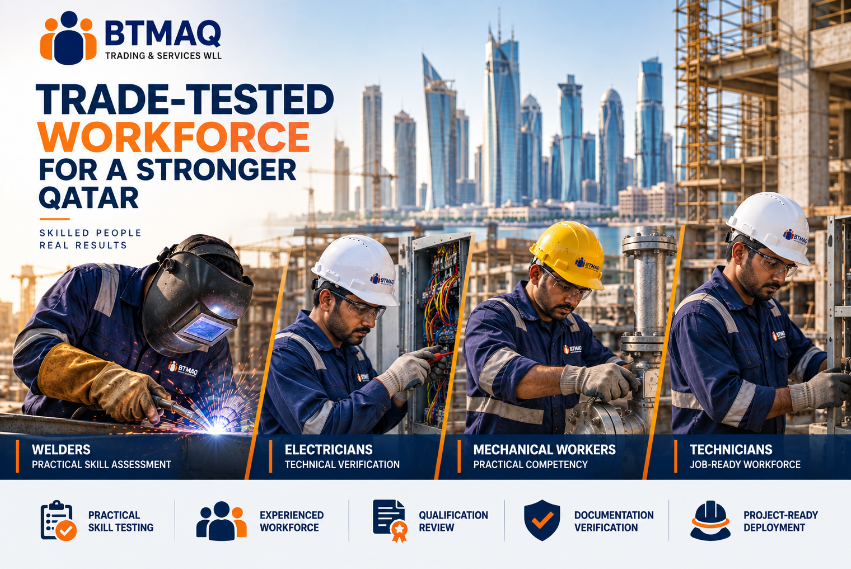
A good workforce evaluation can combine several factors:
Practical Ability + Experience + Qualifications + Documentation + Availability + Assignment Fit
Depending on the role, businesses may also consider safety readiness and project-specific requirements.
This is different from simply asking whether a worker has “passed a trade test.”
How to Choose a Trade-Tested Manpower Supplier
Before selecting a supplier, businesses can ask several practical questions.
Role Understanding
Does the supplier understand the actual job and tasks?
Appropriate Assessment
Does the supplier use a suitable practical or technical assessment where relevant?
Experience Verification
How is previous relevant experience reviewed?
Qualification Checks
Are required qualifications or certifications checked?
Documentation
Are relevant worker documents reviewed before deployment?
Assignment Fit
Does the worker match the location, schedule, working conditions, and actual project requirements?
For supplier licensing and approval considerations, businesses can also review our Licensed Manpower Supplier in Qatar guide.
Why Is a Job Title Not Enough?
Two workers may have the same job title but very different practical experience.
For example, two people may both be called “technicians,” while their experience could involve different equipment, tasks, industries, or working environments.
That is why suppliers and businesses should look beyond the title and understand:
- Actual tasks
- Industry
- Equipment involved
- Required experience
- Qualifications
- Work environment
- Shift conditions
The goal is to match the worker to the actual assignment.
How Should Businesses Request Trade-Tested Manpower?
A clear workforce request should include:
- Exact role
- Actual tasks
- Number of workers
- Industry or work environment
- Required experience
- Required qualifications
- Location
- Start date
- Duration
- Shift conditions
- Project-specific requirements
- Technical assessment expectations, where relevant
Clear information helps the supplier understand what should be assessed and what type of worker is required.
For businesses looking for the wider range of workforce options, our Manpower Supply in Qatar guide covers the broader supply landscape.
How Does Trade-Tested Manpower Supply Work?
A high-level process can look like this:
Role Defined
→ Relevant Candidates Identified
→ Experience Reviewed
→ Trade or Technical Assessment Where Appropriate
→ Qualifications and Documents Reviewed
→ Final Suitability Checked
→ Deployment Planning
The exact process depends on the role, worker category, and business requirement.
Businesses should also consider applicable employment requirements under Qatar’s Labour Law when arranging worker recruitment and employment.
Trade-Tested Manpower vs Blue Collar Manpower
These terms describe different things.
Blue Collar Manpower
→ A workforce category
Trade-Tested Manpower
→ A practical skill verification approach
A worker can therefore be both blue-collar and trade-tested.
Trade-Tested Manpower vs Licensed Manpower Supplier
The distinction is also straightforward.
Licensed Manpower Supplier
→ Licensing, approval, and supplier verification
Trade-Tested Manpower Supplier
→ Practical skill and technical capability verification
One supplier can have both characteristics.
What Affects Trade-Tested Manpower Supply Cost?
There is no fixed rate for every trade-tested workforce requirement.
Cost can depend on:
- Worker role
- Technical specialisation
- Experience
- Number of workers
- Duration
- Working hours or shifts
- Location
- Transportation
- Supervision
- Assessment or qualification requirements where applicable
Trade testing should not automatically be assumed to add one fixed charge to every workforce arrangement.
Common Mistakes When Choosing Trade-Tested Manpower
Assuming “Trade-Tested” Is Enough
Businesses should still check experience, documents, qualifications, availability, and assignment fit.
Not Understanding the Assessment
Ask what practical capability is being evaluated.
Ignoring Experience Verification
A test should not completely replace relevant employment history.
Assuming Qualifications
Job titles should not be used to assume specific certifications.
Giving Only the Job Title
The supplier should understand the actual tasks and work environment.
Confusing Trade Testing With Licensing
Trade testing evaluates worker capability; licensing concerns the supplier or applicable regulatory framework.
Why Choose BTMAQ for Trade-Tested Manpower in Qatar?
BTMAQ’s published manpower approach includes trade testing and workforce verification as part of its broader workforce process.
The actual assessment and verification requirements can depend on the worker’s role, experience, qualifications, and assignment.
Businesses can explore the broader Manpower Services in Qatar page to review available workforce solutions.
For general company information, visit the BTMAQ homepage.
Frequently Asked Questions
What is a trade-tested manpower supplier?
It is a workforce supplier that may use practical or technical assessments for relevant roles to evaluate practical capability.
What is trade testing in manpower supply?
Trade testing is a practical assessment approach used to determine whether a worker can demonstrate relevant technical ability.
Which types of jobs may require trade testing?
Trade testing may be relevant for technical positions such as welding, mechanical, or electrical roles, depending on the actual requirement.
Is trade testing the same as experience verification?
No. Trade testing focuses on demonstrated practical ability, while experience verification focuses on whether the worker has previously performed relevant work.
Is trade testing the same as a qualification check?
No. A trade test evaluates practical capability, while a qualification or certification review checks whether the worker holds the required credential.
Does every worker need to pass a trade test?
No. Trade testing is more relevant to roles where practical technical ability needs to be demonstrated.
How should I request trade-tested manpower in Qatar?
Provide the exact role, tasks, worker quantity, experience, qualifications, location, duration, shifts, and other project-specific requirements.
What should I check besides a trade test?
Check relevant experience, qualifications, documentation, availability, safety readiness where applicable, and whether the worker fits the actual assignment.
Choose Workers Based on Demonstrated Ability
Trade-tested manpower is most useful when a technical role requires more than a job title or CV.
Businesses should look at the complete picture: practical ability, relevant experience, qualifications, documentation, availability, and assignment fit.
That gives businesses a clearer basis for evaluating technical workers before deployment.