








Choosing the right Manpower Supply Company in Qatar can directly affect workforce availability, project continuity, compliance, site readiness and day-to-day operations. Businesses do not simply need a list of available workers. They need a company capable of understanding the requirement, matching suitable people to the work, checking relevant documentation, coordinating mobilization and supporting the workforce after deployment.
This is particularly important in Qatar, where construction, oil and gas, industrial operations, infrastructure, MEP, facility management, logistics, hospitality and other sectors can require large and changing workforce numbers.
A contractor may need additional tradespeople during a critical project phase. A factory may require operational workers for an extended production period. A facility management business may need stable teams across several locations. A project owner may need a combination of skilled, semi-skilled and general workers with different reporting schedules.
The quality of the manpower company therefore matters beyond the initial headcount.
A professional workforce partner should be able to answer practical questions: Are suitable workers actually available? How are their skills checked? What documentation is reviewed? How will they reach the site? Who coordinates attendance? What happens if requirements change? How are replacement or additional manpower requests handled?
BTMAQ Trading & Services WLL currently describes itself as a licensed and Ministry of Labour-approved manpower supply company providing skilled, semi-skilled and unskilled workforce across major sectors in Qatar. Its published information also states 10+ years of operational experience, 500+ workers deployed and WPS-compliant workforce management.
This guide explains what a manpower supply company does, how workforce delivery should work, what businesses should check before selecting a provider, how screening and mobilization operate, and how professional workforce management can support projects after workers reach the site.
Table of Contents
- What Does a Manpower Supply Company in Qatar Do?
- Why Businesses Work With a Professional Manpower Company
- What to Look for in a Manpower Supply Company
- How Workers Are Screened and Verified
- From Client Requirement to Workforce Deployment
- Workforce Management Services in Qatar
- Workforce Mobilization Services in Qatar
- Manpower Documentation and Compliance in Qatar
- Industries Supported by Manpower Companies
- How Project Workforce Is Managed
- Manpower Company vs Recruitment Agency
- Manpower Company vs Direct Recruitment
- Information to Provide Before Requesting Manpower
- How to Compare Manpower Quotations
- Common Mistakes When Choosing a Manpower Company
- Why Choose BTMAQ
- Frequently Asked Questions
What Does a Manpower Supply Company in Qatar Do?
A manpower supply company helps businesses obtain and coordinate workers for defined operational, contract or project requirements.
The process should begin with understanding the client’s workforce problem rather than immediately offering a random list of workers.
A company may ask:
- What work needs to be performed?
- Which job categories are required?
- How many workers are needed?
- What skill level is necessary?
- Where will the workforce be deployed?
- When should deployment begin?
- How long will workers be required?
- What shift pattern will apply?
- Are specific qualifications necessary?
- Are there site-specific safety requirements?
Once the requirement is understood, suitable available manpower can be matched to the assignment.
Depending on the arrangement, the manpower company may also support worker screening, documentation coordination, scheduling, mobilization, attendance communication and ongoing workforce adjustments.
This distinguishes professional manpower delivery from simply sending people to a site.
The company needs to consider whether each worker is appropriate for the assigned role.
A general helper should not automatically be treated as a technical worker. An electrician should not be assumed to meet every project’s technical approval requirements simply because of a job title. Industrial projects may require experience different from ordinary commercial work.
The objective is therefore:
Right role + right worker + right location + right timing + clear responsibilities.
The commercial agreement should then define what the manpower provider and client are each responsible for.
That clarity becomes increasingly important as workforce numbers grow.
Why Businesses Work With a Professional Manpower Company
Businesses use professional manpower companies because workforce demand can change more quickly than permanent recruitment can comfortably support.

A project rarely requires the same number of workers from beginning to end.
Construction activity may move from civil work to MEP, finishing and handover. Industrial operations can experience shutdowns, maintenance periods or production peaks. Hospitality and facility-management businesses may have changing workforce requirements based on contracts and operating schedules.
A manpower company helps businesses respond to those changes more flexibly.
Access to Different Workforce Categories
A project may require several worker categories simultaneously.
For example:
- Technicians
- Electricians
- Plumbers
- Welders
- Operators
- Helpers
- General labour
- Cleaning personnel
- Supervisors
Coordinating every category separately can become difficult for the client.
A manpower company with suitable workforce coverage can simplify that process.
Reduced Recruitment Pressure
Direct recruitment requires candidate sourcing, screening, interviews, documentation and onboarding.
For permanent strategic roles, this investment may make sense.
For a defined project requirement, however, creating a complete recruitment process for dozens of temporary or contract workers may not be efficient.
Workforce Scalability
A business may initially require 20 workers, increase to 50 during the busiest project phase and reduce numbers later.
A structured manpower arrangement can make workforce scaling easier, subject to availability and contract terms.
Project Continuity
Unexpected absence or changes in workforce requirements can affect deadlines.
Professional workforce coordination creates a defined process for communicating these problems rather than leaving each project manager to solve them independently.
Better Workforce Planning
A manpower company can also help clients think beyond total headcount.
A requirement for 100 workers is incomplete unless those workers are divided by role, experience, shift, location and deployment date.
Better planning produces better workforce matching.
What to Look for in a Manpower Supply Company in Qatar
Selecting a Manpower Supply Company in Qatar should involve more than comparing rates.

The provider will potentially be involved in workforce availability, documentation, mobilization and ongoing project support. Businesses should therefore evaluate operational capability as carefully as commercial pricing.
Relevant Industry Capability
First, determine whether the company understands your industry.
A company experienced primarily in hospitality staffing may not automatically understand technical industrial requirements.
Likewise, a provider working with construction manpower should understand the difference between civil trades, MEP personnel, equipment operators and general labour.
Ask which workforce categories the company regularly handles.
Worker Availability
A database containing thousands of names does not necessarily mean thousands of workers are available.
Businesses should distinguish between:
- Registered candidates
- Previously deployed workers
- Workers currently employed elsewhere
- Workers genuinely available for the requested dates
The company should be realistic about availability.
Screening Process
Ask how workers are assessed.
Depending on the role, this may include:
- Experience review
- Technical assessment
- Trade testing
- Qualification checks
- Communication assessment
- Document review
- Safety requirements
The screening method should match the job.
Documentation Awareness
A professional manpower company should understand that workers may require different documentation depending on their role and project.
Requirements should be confirmed before deployment rather than discovered at the site gate.
Mobilization Capability
Finding a worker is only one part of workforce supply.
The company must also coordinate when and where workers report and whether they are ready for the assignment.
Large deployments require considerably more planning than supplying one or two employees.
Clear Communication
Clients should know who their primary contact is.
Large projects may benefit from a dedicated coordinator who can manage:
- Workforce updates
- Attendance issues
- Schedule changes
- Additional requirements
- Replacement requests
Transparent Commercial Terms
Rates should be evaluated together with:
- Included working hours
- Overtime
- Transportation
- Accommodation where applicable
- Meals where applicable
- PPE
- Supervision
- Mobilization
- Replacement
- Contract duration
- Payment terms
A low rate can become expensive if important items were excluded from the original quotation.
Ongoing Support
The relationship should not necessarily end when workers arrive.
Depending on the agreement, workforce support may continue through attendance coordination, replacements, additional manpower or changes in deployment requirements.
How a Manpower Company Screens and Verifies Workers
Workforce quality starts before deployment.
The screening process should be proportionate to the role being filled.

A general labour requirement does not need the same technical assessment as a specialist welding, mechanical or electrical position.
Role Matching
The first step is understanding the job.
A job title alone may not provide enough information.
Two companies requesting “technicians” may actually need completely different experience.
The provider should understand:
- Actual tasks
- Industry
- Equipment involved
- Required experience
- Required qualifications
- Work environment
- Shift conditions
Experience Verification
Relevant employment history can help determine whether a worker has experience related to the assignment.
Years of experience alone should not be the only consideration.
Five years in one work environment may not prepare someone for a completely different technical setting.
Trade Assessment
Technical roles may require practical verification.
Trade testing can be useful for disciplines where the worker’s ability must be demonstrated rather than assumed from a CV.
BTMAQ’s current published process highlights trade testing and workforce verification as part of its manpower approach.
Qualification and Certification Review
Where the project requires particular qualifications, those requirements should be identified before deployment.
Businesses should avoid assuming that every worker with a particular job title holds every certification that might be required for that role.
Safety Readiness
Workers entering construction, industrial or other controlled sites may require:
- PPE
- Safety awareness
- Site induction
- HSE-related training
- Client-specific orientation
The exact requirement depends on the assignment.
Final Suitability
A technically capable worker can still be unsuitable if the schedule, location or contract conditions do not match availability.
Effective verification therefore combines ability + documentation + availability + assignment fit.
From Client Requirement to Workforce Deployment
A professional manpower company should use a structured delivery process.
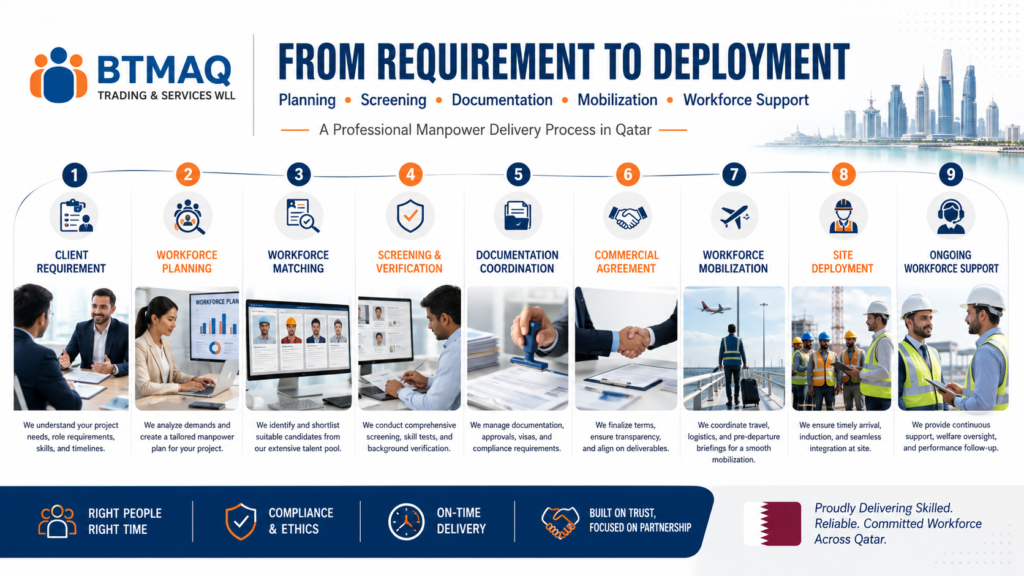
1. Requirement Analysis
The process begins when the client explains the requirement.
Important information includes:
- Worker categories
- Quantity
- Location
- Start date
- Duration
- Working hours
- Shift requirements
- Experience
- Technical requirements
- Site conditions
Incomplete requirements create delays later.
2. Workforce Planning
The requirement is divided into actual workforce needs.
Instead of:
“We need 60 people.”
a useful plan may become:
- 10 electricians
- 8 plumbers
- 12 technicians
- 25 helpers
- 5 supervisors
This gives the provider something measurable to fulfil.
3. Workforce Matching
Available personnel are compared with the role requirements.
Matching should consider more than job title.
4. Screening and Verification
Relevant skills, experience and documentation are reviewed.
Specialised roles may require additional assessment.
5. Documentation Coordination
The parties identify the documents, approvals and site requirements necessary before deployment.
6. Commercial Agreement
The agreement should define:
- Scope
- Rates
- Hours
- Overtime
- Duration
- Transportation
- Supervision
- Replacement arrangements
- Other included or excluded services
7. Workforce Mobilization
Selected workers are scheduled and prepared to report according to the agreed plan.
8. Site Deployment
Workers report to the designated project or operational location.
Clear reporting instructions are especially important for large teams.
9. Ongoing Workforce Support
After deployment, workforce requirements may change.
The client may need additional personnel, replacements, revised shifts or different deployment quantities.
A professional manpower relationship therefore requires communication throughout the agreed workforce period.
Workforce Management Services in Qatar
Workforce supply does not necessarily stop when workers arrive at the project.

Workforce Management Services in Qatar can involve coordinating the deployed workforce so that agreed manpower remains aligned with operational requirements.
The exact service scope depends on the commercial arrangement, but workforce management may involve:
- Attendance coordination
- Shift planning
- Workforce allocation
- Absence communication
- Replacement coordination
- Supervisor communication
- Headcount tracking
- Workforce adjustments
- Project workforce continuity
For larger projects, even simple attendance management can become significant.
If a project has 150 workers across several shifts, manual communication between individual workers and project management can become inefficient.
A clear reporting hierarchy can help.
For example:
Workers → Team Leader → Supervisor → Workforce Coordinator → Client Representative
The structure does not need to be complicated, but responsibilities should be clear.
Workforce management also becomes important when project requirements change.
If one work package finishes while another expands, the client may need to adjust workforce allocation.
The goal is to keep workforce capacity aligned with actual operational demand instead of allowing headcount and workload to move in different directions.
Workforce Mobilization Services in Qatar
Workforce Mobilization Services in Qatar focus on preparing and coordinating workers so they can move from selection to actual project deployment.
Mobilization is broader than simply telling workers where to report.
A proper mobilization plan may consider:
- Worker confirmation
- Documentation readiness
- Job assignment
- Reporting date
- Reporting location
- Transportation
- PPE
- Site access requirements
- Induction requirements
- Shift allocation
- Supervisor contacts
Large workforce mobilizations may need to be phased.
For example, a contractor requiring 120 workers might need:
- 30 workers during preparation
- another 50 as major activity begins
- the remaining workforce during the peak phase
Phased mobilization can prevent unnecessary workers from arriving before they are required.
Project location also matters.
Mobilization to a central Doha location can create different logistical requirements from deployment to an industrial or remote project area.
Businesses should therefore provide location information early.
Speed is useful, but deployment should not sacrifice worker suitability or readiness.
The best mobilization process delivers workers when required and prepared for the assignment, rather than simply delivering the largest number as quickly as possible.
Manpower Documentation and Compliance in Qatar
Documentation and compliance are essential parts of professional manpower operations.

Qatar’s Ministry of Labour is responsible for functions including supervising implementation of the Labour Law, issuing work permits, supervising fair recruitment of expatriate workers, monitoring occupational safety and health, and inspecting establishments for compliance.
Workforce documentation requirements can vary according to the worker, role, employer arrangement and project.
Areas that businesses may need to consider include:
- Identity documentation
- Work authorization
- Employment records
- QID-related requirements
- Qualifications
- Trade certificates
- Medical requirements where applicable
- Safety records
- Site approvals
- Client-specific documentation
Wage administration is another important compliance area.
Qatar’s Wage Protection System requires employers covered by the relevant rules to transfer worker wages through financial institutions. The applicable ministerial decision states that wages should be transferred through WPS within seven days of their due date.
The commercial relationship should clearly define which party manages employment administration and which party manages operational supervision.
Working hours and overtime also need to be planned according to applicable requirements rather than treated as unlimited simply because a project deadline is approaching.
Safety responsibilities should be addressed before work begins.
Workers should understand their assigned duties, and specialist tasks should only be given to people with the appropriate capability and authorization.
For clients, the practical principle is simple:
Do not wait until mobilisation day to discover a documentation or compliance requirement.
Confirm requirements during workforce planning.
Industries Supported by Manpower Supply Companies in Qatar
A capable manpower company may support different workforce requirements across several industries.

BTMAQ’s current published service coverage includes construction, oil and gas, industrial operations, logistics, hospitality, facility management, infrastructure and related manpower categories.
Construction
Construction projects can require:
- Masons
- Carpenters
- Steel fixers
- Electricians
- Plumbers
- Welders
- Operators
- Helpers
- General labour
- Supervisors
Requirements can change as the project moves through different phases.
Oil and Gas
Oil and gas manpower can include technical and safety-sensitive roles requiring specific experience or project qualifications.
Requirements should be clearly defined before workers are proposed.
Industrial and Manufacturing
Factories, workshops and industrial facilities may require:
- Operators
- Maintenance technicians
- Fabricators
- Fitters
- Helpers
- Material handlers
- Production support workers
Shift structure can be particularly important in continuous operations.
MEP
Mechanical, electrical and plumbing activities may require experienced technical workers and support personnel.
Role-specific verification should be considered where appropriate.
Infrastructure
Road and infrastructure projects may use civil workers, operators, helpers, tradespeople and supervisory manpower.
Large sites can also create significant transportation and workforce coordination requirements.
Facility Management
Facility-management companies often require stable manpower for:
- Cleaning
- Maintenance
- HVAC
- Electrical work
- Plumbing
- General technical support
Logistics and Warehousing
Operational requirements can include loaders, warehouse helpers, forklift operators, packers and inventory-related personnel.
Hospitality
Hotels, catering businesses and event operations may require housekeeping, kitchen, F&B, service and general support workers.
Cleaning
Cleaning manpower can serve commercial, hospitality, construction and industrial environments.
The required training and equipment depend on the work involved.
How Manpower Companies Manage Project Workforce
Project workforce management begins with understanding that manpower demand changes with the project schedule.
A contractor should not necessarily expect the same headcount during mobilization, peak execution and handover.
Workforce Allocation
Workers should be assigned according to actual tasks.
If one team is overloaded while another has insufficient work, total project headcount may appear adequate while productivity remains poor.
Shift Planning
Where projects operate across multiple shifts, workforce numbers should be calculated separately for each shift.
A requirement for 50 workers continuously is very different from 50 workers working one daytime shift.
Supervisor Structure
Large teams need clear reporting lines.
Without this, basic issues can reach senior project management unnecessarily.
Attendance
Attendance information helps confirm whether planned manpower is actually available each day.
Workforce Continuity
For longer assignments, maintaining stable teams can help workers become familiar with:
- Site layout
- Procedures
- Supervisors
- Safety expectations
- Operational routines
Headcount Changes
Project requirements can increase or decrease.
The manpower agreement should explain how additional workers, reductions or role changes are handled.
Contingency Planning
Absence, leave, reassignment and schedule changes can create workforce gaps.
Planning how these situations are communicated helps protect project continuity.
Manpower Supply Company vs Recruitment Agency
The terms manpower supply and recruitment are sometimes used loosely, but the commercial models can be different.
A recruitment agency generally helps a business identify and hire candidates.
A manpower supply arrangement is normally focused on providing workforce under an agreed supply or deployment structure, with responsibilities determined by the contract.
| Factor | Manpower Supply Company | Recruitment Agency |
| Main objective | Supply/deploy workforce | Find candidates for hiring |
| Common use | Project and operational manpower | Permanent or direct recruitment |
| Worker sourcing | Part of service | Core service |
| Mobilization | Often relevant | Usually not the main service |
| Workforce coordination | May continue after deployment | Often limited after hiring |
| Project scaling | Common requirement | Depends on recruitment model |
| Commercial structure | Workforce supply agreement | Recruitment fee/placement model |
The exact legal and operational structure varies by provider and contract, so businesses should confirm responsibilities instead of relying only on terminology.
A company looking for a permanent finance manager, for example, may need recruitment support.
A contractor requiring dozens of workers for a defined operational project may need a manpower supply arrangement.
Manpower Supply Company vs Direct Recruitment
Direct recruitment and manpower supply can also serve different purposes.
Direct recruitment may be suitable when a business wants an employee to become part of its permanent internal workforce.
This is common for:
- Management
- Specialist corporate roles
- Long-term strategic positions
- Core internal functions
Manpower supply is often more suitable where demand is tied to:
- Project phases
- Contract duration
- Changing headcount
- Site operations
- Temporary capacity requirements
The main distinction is workforce flexibility.
Hiring 80 permanent employees for a project that may need those workers only during a specific phase can create a different long-term commitment from using an agreed workforce supply arrangement.
Neither option is automatically superior.
Businesses often use both.
Permanent employees may form the core management and technical team, while supplied manpower provides additional capacity as project requirements change.
What Information Should You Give a Manpower Company?
Better information produces a better manpower proposal.
Before requesting a quotation, prepare the following.
Required Job Categories
Do not write:
50 manpower required.
Instead write:
- 10 electricians
- 10 plumbers
- 20 helpers
- 8 general workers
- 2 supervisors
Quantity
Specify numbers by role.
Location
Provide the actual project location or operational area.
Start Date
State when workers are expected to report.
Duration
Explain whether the requirement is for days, weeks, months or longer.
Working Hours
Provide standard hours and anticipated overtime.
Shift Pattern
State whether the project requires:
- Day shift
- Night shift
- Rotating shifts
- Multiple teams
Experience Requirements
Explain relevant industry or technical experience.
Qualifications
List mandatory qualifications or certifications where applicable.
PPE
Clarify requirements and responsibility for providing equipment.
Transportation
State who is expected to arrange workforce transportation.
Site Requirements
Include any known induction, access or documentation requirements.
Supervisor Requirements
Explain whether team leaders or supervisors are required.
A complete requirement helps the manpower company determine both worker availability and the true commercial scope.
How to Compare Manpower Company Quotations
Comparing only the final hourly or monthly rate can be misleading.
Two quotations can have the same headline price but very different inclusions.
Businesses should compare:
Worker Category
Confirm that both suppliers are quoting workers with comparable experience and qualifications.
Standard Working Hours
Check what the quoted rate actually covers.
Overtime
Understand how overtime is calculated.
Transportation
Determine whether workforce transport is included.
Accommodation
Where relevant, confirm whether accommodation responsibilities are included or excluded.
PPE and Uniform
Check what equipment or clothing is provided.
Supervision
Large teams may need project coordinators or supervisors.
Confirm whether these are included.
Mobilization
Ask whether deployment-related logistics create separate charges.
Replacement
Understand the process and commercial terms if a worker must be replaced.
Contract Duration
Check minimum periods, notice requirements or other duration conditions.
Payment Terms
Commercial terms can affect overall cash flow even when rates appear similar.
The goal is to compare total workforce value and responsibility, not merely the smallest number on the quotation.
Common Mistakes When Choosing a Manpower Supply Company
Several avoidable mistakes can create workforce problems after deployment begins.
Choosing Only by Lowest Price
A cheaper quotation does not automatically represent better value.
The comparison must consider inclusions, worker quality and service scope.
Providing an Unclear Requirement
A vague manpower request produces vague workforce matching.
Failing to Confirm Availability
Workers shown in a database may not be available for your required start date.
Ignoring Documentation Until Mobilization
Missing documentation can delay project access.
Not Defining Working Hours
Unclear hours and overtime arrangements can create disputes.
Ignoring Transportation
Workers cannot perform if transport arrangements prevent them from reaching the site on time.
No Replacement Procedure
Clients should understand what happens if a worker becomes unavailable or unsuitable.
Using General Workers for Specialist Roles
Job titles and responsibilities must be matched properly.
Safety-sensitive or technical work should be performed by workers with appropriate competence.
No Clear Communication Contact
Clients should know who handles operational manpower issues.
Treating Every Project the Same
A hotel, construction site, industrial plant and logistics warehouse have very different workforce requirements.
The manpower plan should reflect the actual environment. this is important.
Why Choose BTMAQ as a Manpower Supply Company in Qatar?
BTMAQ Trading & Services WLL provides manpower solutions for businesses and projects across Qatar.
According to its currently published company information, BTMAQ states that it is licensed and Ministry of Labour approved, operates WPS-compliant workforce management, has more than 10 years of operational experience and has deployed more than 500 workers. do you know anything for this?
Its published workforce coverage includes:
- Skilled manpower
- Semi-skilled manpower
- Unskilled manpower
- Technical workers
- General labour
- Project workforce
BTMAQ also publishes manpower coverage across sectors such as:
- Construction
- Oil and gas
- Industrial operations
- MEP
- Infrastructure
- Logistics
- Warehousing
- Hospitality
- Cleaning
- Facility management
Its current website describes workforce planning, trade testing and verification, documentation, mobilization and ongoing support as elements of its manpower delivery approach.
For businesses, the most effective way to begin is to provide a complete manpower requirement.
That allows the workforce request to be assessed according to the actual role, quantity, schedule, location and project conditions rather than offering a generic solution.
Frequently Asked Questions About Manpower Supply Companies in Qatar
What does a Manpower Supply Company in Qatar do?
A Manpower Supply Company in Qatar helps businesses obtain workforce for project, contract and operational requirements. Depending on the agreement, services may include workforce matching, screening, documentation coordination, mobilization and ongoing manpower support.
What types of workers can a manpower company provide?
Workforce categories can include skilled trades, semi-skilled personnel, general labour, industrial workers, technicians, operators, facility-management workers, hospitality staff and other operational roles depending on company capability and worker availability.
How do I choose a manpower company in Qatar?
Evaluate relevant industry experience, workforce availability, screening procedures, documentation awareness, mobilization capability, communication, commercial transparency and ongoing workforce support.
How are workers screened?
Screening depends on the role and can include experience review, skills assessment, trade testing, qualification checks, document review and project-specific requirements.
What documents should be checked before deployment?
Requirements vary by project but may include identity and employment documents, relevant qualifications, trade certificates, site documentation, safety records and other client-specific requirements.
What are Workforce Management Services in Qatar?
Workforce management can include attendance coordination, scheduling, workforce allocation, absence communication, replacement coordination and ongoing management of deployed teams.
What are Workforce Mobilization Services in Qatar?
Workforce mobilization involves preparing workers for deployment, including scheduling, documentation readiness, reporting instructions, transportation, site access requirements, induction and deployment coordination.
Can a manpower company help with worker replacement?
Replacement arrangements depend on the manpower agreement. Businesses should confirm the process, timelines and commercial terms before deployment begins.
Can manpower companies support large workforce requirements?
Companies with sufficient operational capability may coordinate larger requirements, but bulk deployments require planning for worker categories, availability, documentation, transportation, supervision and scheduling.
Which industries use manpower supply companies?
Construction, oil and gas, industrial, MEP, infrastructure, facility management, logistics, warehousing, hospitality and cleaning are among the industries that may use supplied manpower.
What is the difference between a manpower company and a recruitment agency?
Recruitment agencies primarily help employers find candidates for hiring. Manpower supply companies focus on providing workforce under an agreed supply/deployment arrangement. Exact responsibilities depend on the provider and contract.
Is manpower supply the same as direct recruitment?
No. Direct recruitment generally means hiring employees directly into the client’s organisation. Manpower supply is commonly used for flexible, operational, contract or project workforce requirements.
What should I include in a manpower request?
Provide worker categories, quantity, project location, start date, duration, working hours, shifts, required experience, qualifications, transportation, PPE and site-specific requirements.
How should businesses compare manpower quotations?
Compare workforce category, standard hours, overtime, transport, accommodation where applicable, PPE, supervision, mobilization, replacement arrangements, contract duration and payment terms—not only the headline rate.
Choose a Manpower Company Based on Capability, Not Only Headcount
A professional Manpower Supply Company in Qatar should do more than provide a number of workers.
Effective workforce supply starts with understanding what the client actually needs.
The requirement must then be translated into appropriate worker categories, skill levels, quantities, schedules and deployment dates.
Workers need to be matched to their roles.
Relevant capabilities and documentation should be reviewed.
Mobilization must be coordinated.
Once the workforce reaches the project, communication and workforce management become important for maintaining continuity.
This end-to-end approach is especially valuable for contractors, industrial businesses, facility-management companies and project owners managing changing workforce requirements across Qatar.
When evaluating a manpower company, businesses should therefore ask:
- Does the company understand our industry?
- Are suitable workers genuinely available?
- How are workers screened?
- How is documentation handled?
- How does mobilization work?
- Who manages workforce issues after deployment?
- Are commercial terms transparent?
- What happens if our requirements change?
The answers reveal much more than a headline rate.
BTMAQ Trading & Services WLL provides manpower solutions across Qatar based on workforce category, quantity, duration and project requirements.
For an accurate proposal, businesses should prepare a detailed workforce requirement covering the required roles, headcount, location, schedule and project-specific conditions before requesting manpower.
Request a Manpower Proposal
Contact BTMAQ Trading & Services WLL with your workforce requirement.
Email: info@manpoweragencyinqatar.com
Location: Doha, Qatar
Share the required worker categories, quantity, project location, start date, working hours and expected duration so the manpower requirement can be reviewed properly.